Answering questions with Machinations
Use a Machinations diagram to frame a question, make assumptions visible and inspect how a system behaves. In this introductory tutorial to Machinations.
In this introductory tutorial to Machinations, we will show you how to find answers to the numerous questions that you might encounter while constructing events, systems, and models.
Start your learning journey
If you are eager to find out how to create your own version of the Willy Wonka Factory trip experiment, we recommend checking out our dedicated learning pathways:
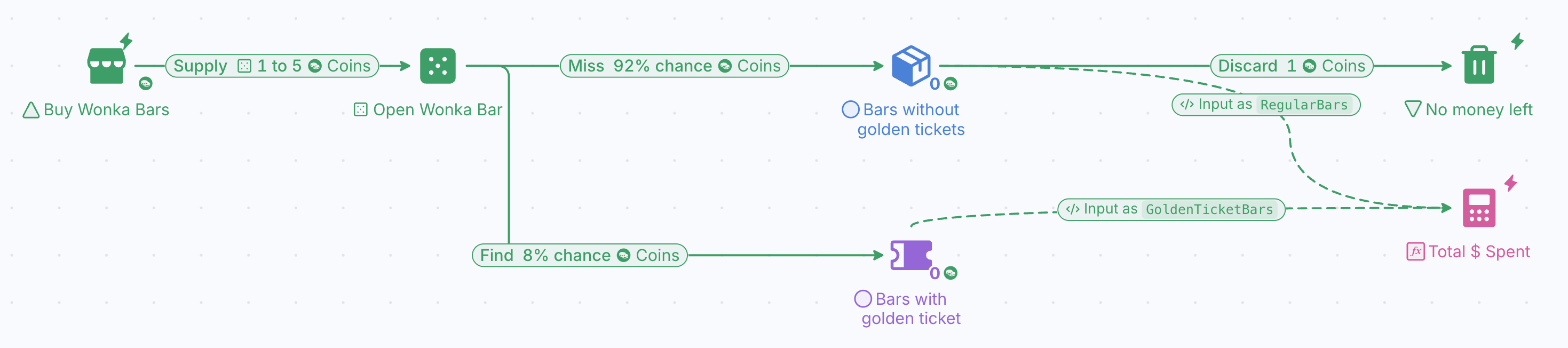
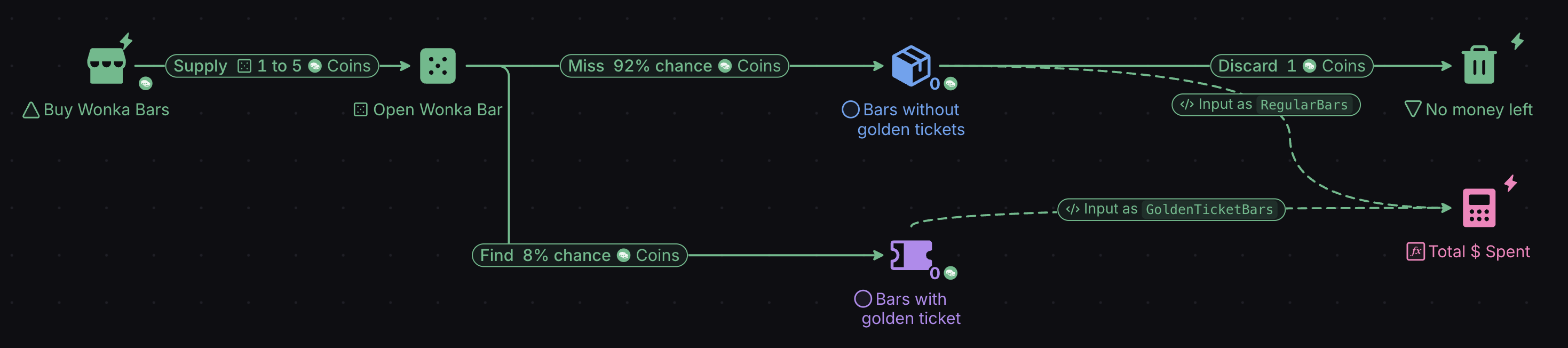
What is Machinations?
Machinations offers a powerful framework for designing, testing, and optimizing complex systems through interactive, playable diagrams. Whether you’re modeling feedback loops, economies, or intricate interactions, Machinations provides an elaborate and universal modeling language that transforms your conceptual ideas into dynamic digital twins. This approach allows designers to visualize their systems, explore various scenarios in real time, and fine-tune parameters to uncover potential flaws, gain deeper insights, and reduce guesswork.
The purpose of our tool is to bring data-driven decision-making to the forefront by utilizing the following features:
- Monte Carlo Forecasts – Gain accurate insight in a safe virtual environment with one click of a button;
- Forecast analytics – Identify patterns and averages, detect bottlenecks, and understand the overall system’s dynamics;
- WYSIWYG editor – Defines the rules of any system by adding nodes with an intuitive drag&drop interface;
- Built-in Randomness – Integrates weighted & percentage distributions, chance-based events, and random choices;
- Agents – Let artificial agents play your model and add dynamic decision-making to your forecasts;
- Spreadsheet Integration – Transforming static data into dynamic, actionable models;