Research behind Machinations
Machinations grew out of academic work on game systems and visual modeling. Explore 38 publications about the framework and how others have used it, from doctoral theses to conference papers.
Publications
Each entry shows the first page or volume cover of the publication where one is available. A dashed placeholder means no cover image was available; it only repeats the title, venue and year.
Twilight Bazaar: Engineering Emergence through Higher Orderness in Games
Muhammad Rakha · 2026
Thesis Master's thesis, Aalto University · aaltodoc.aalto.fi
Builds on Dormans's emergence-through-feedback theory, draws a Machinations diagram of the game's bargaining and social loops and reports where Machinations stops being the right tool.
Designing Emergent Narrative through Character-Driven Game Systems
Alina Qureshi · 2026
Thesis Master's thesis, Aalto University · aaltodoc.aalto.fi
Describes a team prototyping survival and social resource flows in Machinations and playtesting those prototypes (figure 9).
Game Analysis using Gameplay Design Patterns, MDA, and Machinations
Yanghong Liu, Yanmei Cui · 2026
Preprint SSRN preprint · doi.org
Analyses No Thanks! and Catan with gameplay design patterns, MDA and Machinations (named in the title; its exact role is not described in the abstract).
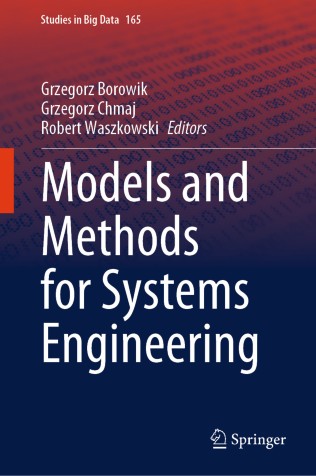
K-Machinations: Testing and Repairing Machinations Diagrams
Andrei Cotor, Alexandru Cantor, Florin Craciun · 2025
Book chapter Studies in Big Data (Models and Methods for Systems Engineering), Springer · doi.org
Proposes tooling for testing and repairing Machinations diagrams, as its title states.
Tula Online Tool for Balancing Video Games
Valeria Rakhmankulova, Vlada Kugurakova · 2025
Journal article Russian Digital Libraries Journal 28(4) · doi.org
Builds a rival balancing tool and compares it with Machinations, reporting input-validation and usability gaps found in Machinations.
Balancing and Analyzing Player Interaction in the ESG+P Game with Machinations
Leandro Ouriques, Farmy Silva, Marcus Parreiras, Marcos Magalhães, Geraldo Xexéo · 2024
Journal article Journal on Interactive Systems 15(1), SBC · doi.org
Builds two Machinations models (random vs interactive play with four player strategies) of an educational game and compares win rates over batch simulations.
Creación de ALPHA, un startup de corretaje de cereales y oleaginosas (MENA)
Julia Fernández Taylor · 2024
Thesis Final degree project, Universidad Politécnica de Cartagena · repositorio.upct.es
Uses machinations.io (not a game) to simulate a start-up's monthly revenue under optimistic, neutral and pessimistic scenarios.
GEEvo: Game Economy Generation and Balancing with Evolutionary Algorithms
Florian Rupp, Kai Eckert · 2024
Conference paper IEEE Congress on Evolutionary Computation (CEC) · doi.org
Simulates generated economies with a lightweight framework inspired by Machinations and Micro-Machinations.
Balanceamento do jogo ESG+P utilizando o Machinations: um Estudo de Caso
Farmy Silva, Leandro Ouriques, Marcus Parreiras, Marcos Magalhães, Geraldo Xexéo · 2023
Conference paper SBGames 2023 (extended track), SBC · doi.org
Balances a sustainability board game by building and batch-simulating its economy as Machinations diagrams (case study).
Conceptual Framework for Designing Virtual Field Trip Games
Amani Alsaqqaf (supervisor F. Li) · 2023
Thesis PhD thesis, Durham University · etheses.durham.ac.uk
Uses Machinations-style internal-economy diagrams to quantify experiential learning theory and balance task difficulty in a learning game.
Methodik zur Gamification-basierten Identifikation von Nutzungsanforderungen und Konzeption von Produktmerkmalen
David Kessing (eds. M. Löwer, N. Schlüter) · 2023
Thesis Doctoral series, University of Wuppertal (Product Safety and Quality Engineering) · elekpub.bib.uni-wuppertal.de
Uses machinations.io as the game-balance simulation tool to evaluate gamification strategies (extends his AHFE 2022 paper that the site already lists).
Game Balance Tools (Инструменты балансирования игр)
Gulnara Sahibgareeva, Vlada Kugurakova, Eduard Bolshakov · 2023
Journal article Russian Digital Libraries Journal 26(2) · doi.org
Surveys balancing tools and runs experiments with Machinations to test and tune mathematical balance (game economy), including in a prototype-generation pipeline.
Análise e modelagem de jogos digitais: relato de uma experiência educacional utilizando metodologias ativas
David Lemes, Ezequiel dos Santos, Eduardo Romanek, Celso Fujimoto, Adriano Valente · 2023
Preprint arXiv preprint (CoBICET 2024) · doi.org
A multidisciplinary student team chose machinations.io over Twine to prototype a low-fidelity game.
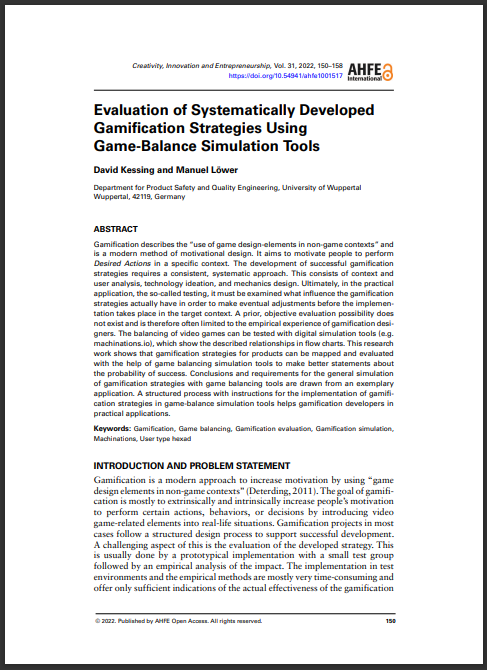
Evaluation of Systematically Developed Gamification Strategies with Game-Balance Simulation Tools
David Kessing, Manuel Löwer · 2022
Conference paper AHFE International conference proceedings, CMS Conferences · openaccess.cms-conferences.org
This research work shows that gamification strategies for products can be mapped and evaluated with the help of game balancing simulation tools to make better statements about the probability of success.
Investigating balance process in entrepreneur gamified scenarios
Michelle Mayumi Tizuka, Esteban Clua, Luciana Salgado · 2022
Conference paper SBGames 2022 (extended track), SBC · doi.org
Uses the Machinations framework (a progression template) to test long-term balancing of gamified entrepreneurship scenarios and feeds the results back to project managers.
Game Balance Practices (Практики балансирования компьютерных игр)
Gulnara Sahibgareeva, Vlada Kugurakova · 2022
Journal article Program Systems: Theory and Applications 13(3) · doi.org
Uses the Machinations online editor to avoid building its own visualization and simulation of an in-game economy.
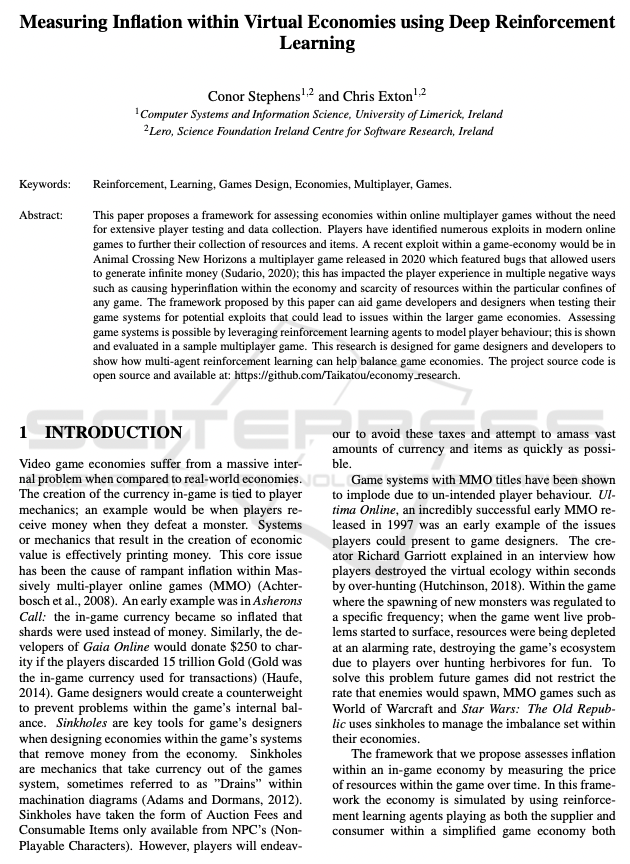
Measuring Inflation within Virtual Economies using Deep Reinforcement Learning
Conor Stephens, Chris Exton · 2021
Conference paper SCITEPRESS conference proceedings · scitepress.org
This paper proposes a framework for assessing economies within online multiplayer games without the need for extensive player testing and data collection. It can aid game developers and designers when testing their game systems for potential exploits that could lead to issues within the larger game economies.
Teoria dynamik gier (Theory of game dynamics)
Marcin Petrowicz · 2020
Thesis Doctoral dissertation, Jagiellonian University · ruj.uj.edu.pl
Analyses the game Klanarchia using Dormans's Machinations application to visualize resource flow, alongside an Overwatch case.
Semi-automatic construction of video game design prototypes with MaruGen
Italo Felipe Capasso-Ballesteros, Fernando De la Rosa · 2020
Journal article Revista Facultad de Ingeniería, Universidad de Antioquia · doi.org
MaruGen (Machinations Ruleset Generator) generates mechanics from the Machinations framework and spaces/missions from the Mission-Space framework.
Systems & design thinking: from practice to theory in game design
Jonne Harja · 2020
Thesis Bachelor thesis, University of Jyväskylä · urn.fi
Reviews systems thinking in game design and devotes a subsection plus a screenshot figure to machinations.io as the only professional simulation tool.
The design of indie games, a different paradigm
Enrique Alejandro Domínguez Pérez · 2019
Thesis Doctoral thesis, University of Bayreuth · doi.org
Presents Machinations as one of the formal design tools and reproduces Dormans's diagram of Settlers of Catan (illustration 3.13).
Mek: Mechanics Prototyping Tool for 2D Tile-Based Turn-Based Deterministic Games
Rokas Volkovas, Michael Fairbank, John Woodward, Simon Lucas · 2019
Conference paper IEEE Conference on Games (CoG) · doi.org
Compares its own mechanics-prototyping language with Machinations, called the most formalized design tool to date.
Taking Level Generation to the Next Level
Nicky Wild (advisors J. Dormans, A. Bouwer, S. Leijnen) · 2018
Thesis Bachelor thesis, Amsterdam University of Applied Sciences / Ludomotion · andersbouwer.wordpress.com
Uses the Micro-Machinations library (a Machinations derivative) as one of two design tools for adapting and balancing mechanics during level generation.
Modelagem de jogos de adventure através de Machinations
Laiza Costa Camurugy · 2017
Thesis Undergraduate monograph, Universidade Federal da Bahia · repositorio.ufba.br
Models adventure games (a published title and Cloak of Darkness) in Machinations and compares the result with Petri-net models.
Extension of Machinations Framework (Rozšíření frameworku Machinations)
Robert Guth (advisor Jakub Gemrot) · 2017
Thesis Master's thesis, Charles University, Faculty of Mathematics and Physics · hdl.handle.net
Extends the Machinations framework so it can simulate board-game mechanics without simplification and models the game Stone Age as a case study.
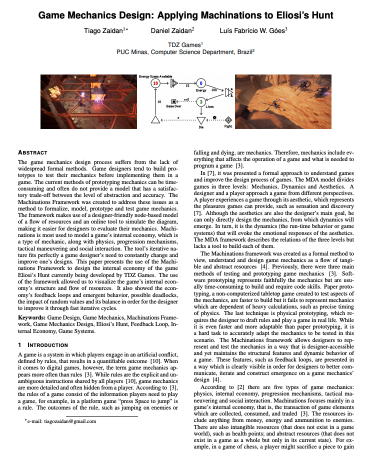
Game Mechanics Design: Applying Machinations to Eliosi’s Hunt
Tiago Zaidan, Daniel Zaidan, Luis Fabricio W. Goes · 2016
Conference paper SBGames 2016 · sbgames.org
This paper presents the use of the Machinations Framework to design the internal economy of the game Eliosi’s Hunt currently being developed by TDZ Games. The use of the framework allowed us to visualize the game’s internal economy’s structure and flow of resources (...) in order for the designer to improve it through fast iterative cycles.
Game Design Tools: Can they Improve Game Design Practice?
Katharine Neil · 2016
Thesis Doctoral thesis, HAL theses archive · tel.archives-ouvertes.fr
This paper contributes practice-led evaluation research to the question of whether game design tools can effectively support and expand game design practice. It offers insights that can be used to inform future game design tool development.
Gamification of Prosocial Learning for Increased Youth Inclusion
Kam Star (PLAYGEN) · 2016
Report EU project deliverable D4.3, Horizon 2020 (CORDIS project 644204) · cordis.europa.eu
The prosocial skill games model - which is an abstract game model for teaching prosocial skills - is presented along with the first iteration of the prosocial world data model. The first iteration of a range of game mechanics and game systems together with rules intended to produce gameplay that leads to increased proficiency in prosocial skills.
Rancang Bangun Aplikasi Edutainment untuk Anak SD dengan Teknik Gamifikasi Berbasis Octalysis dan Machinations Framework
Ardha Putra Santika (advisors D. Herumurti, I. Kuswardayan) · 2016
Thesis Jurnal Teknik ITS / undergraduate thesis, Institut Teknologi Sepuluh Nopember · repository.its.ac.id
Designs gamification with the Octalysis framework and visualizes it as an interactive Machinations model before building the mobile app.
Rachinations: Modelando a Economia Interna de Jogos
Felipe de Queiroz Badejo Almeida (advisor G. Xexéo) · 2015
Thesis Undergraduate thesis, UFRJ · ludes.cos.ufrj.br
Builds Rachinations, a Ruby-based DSL and engine that reproduces Machinations diagrams in code, and uses it to simulate simple game economies.
Adapting Game Mechanics with Micro-Machinations
Riemer van Rozen, Joris Dormans · 2014
Conference paper Foundations of Digital Games (FDG 2014) · hal.archives-ouvertes.fr
An approach for designing, embedding, and adapting game mechanics iteratively in games. It shows "that mm enables the adaptability needed to reduce design iteration times, consequently increasing opportunities for quality improvements and reuse".
Order of Battle: A Case Study for Designing Emergent Structure in Games
Stefan Leijnen, Joris Dormans · 2014
Conference paper CoSMoS 2014 workshop proceedings, Luniver Press · www-users.york.ac.uk
Models a game based on Rayleigh-Benard convection with Machinations diagrams (figure 2) to study emergent structure.
Micro-Machinations: A DSL For Game Economies
Paul Klint, Riemer van Rozen · 2013
Book chapter Software Language Engineering (SLE 2013), Springer · link.springer.com
Micro-machinations (mm) details and formalizes the meaning of a significant subset of machination’s language features and adds several new features most notably modularization. This paper "shows that it is feasible to rapidly simulate game economies in early development stages and to separate concerns".
Engineering emergence: applied theory for game design
Joris Dormans · 2012
Thesis Doctoral thesis, University of Amsterdam · dare.uva.nl
This research examines the nature of emergence in games in order to construct applied theory to deal with emergence in games head-on. This theory will enable the designer to get more grip on the elusive process of building quality games displaying emergent behavior.
Game Mechanics: Advanced Game Design
Ernest Adams, Joris Dormans · 2012
Book New Riders · google.de
Craft mechanics that generate challenging, enjoyable, and well-balanced gameplay. Discover at what stages to prototype, test, and implement mechanics in games and learn how to visualize and simulate game mechanics to design better games.
Game design tools: Time to evaluate
Katharine Neil · 2012
Conference paper Nordic DiGRA 2012 · doi.org
Positions Machinations among formal game-design tools whose effect on design practice should be evaluated.
Simulating Mechanics to Study Emergence in Games
Joris Dormans · 2011
Conference paper AAAI Conference on Artificial Intelligence and Interactive Digital Entertainment (AIIDE 2011) · ojs.aaai.org
This paper presents the latest version of the machinations framework that uses diagrams to represent the flow of tangible and abstract resources through a game. This flow represents the mechanics that make up a game’s internal economy and has a large impact on the emergent gameplay of most simulation games, strategy games, and board games.
Integrating Emergence and Progression
Joris Dormans · 2011
Conference paper DiGRA 2011 Conference · doi.org
Uses Machinations diagrams to model mission mechanics and feedback loops that govern level progress, including an interactive diagram.
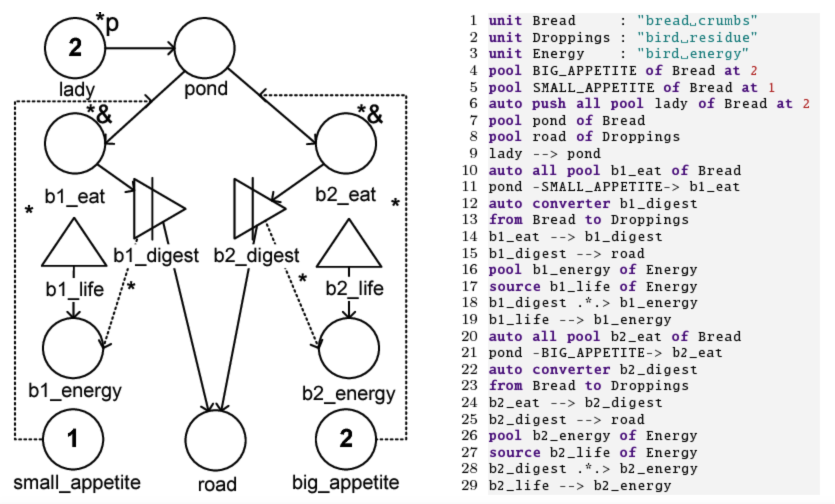
Build on the research with a model of your own
Draw the system from a paper, Play it and share it with your students or co-authors in a link.