Business process modeling software
Model the relationships between a business process and the wider system of people, resources, dependencies and goals, to explore how a process change could affect other parts of it.
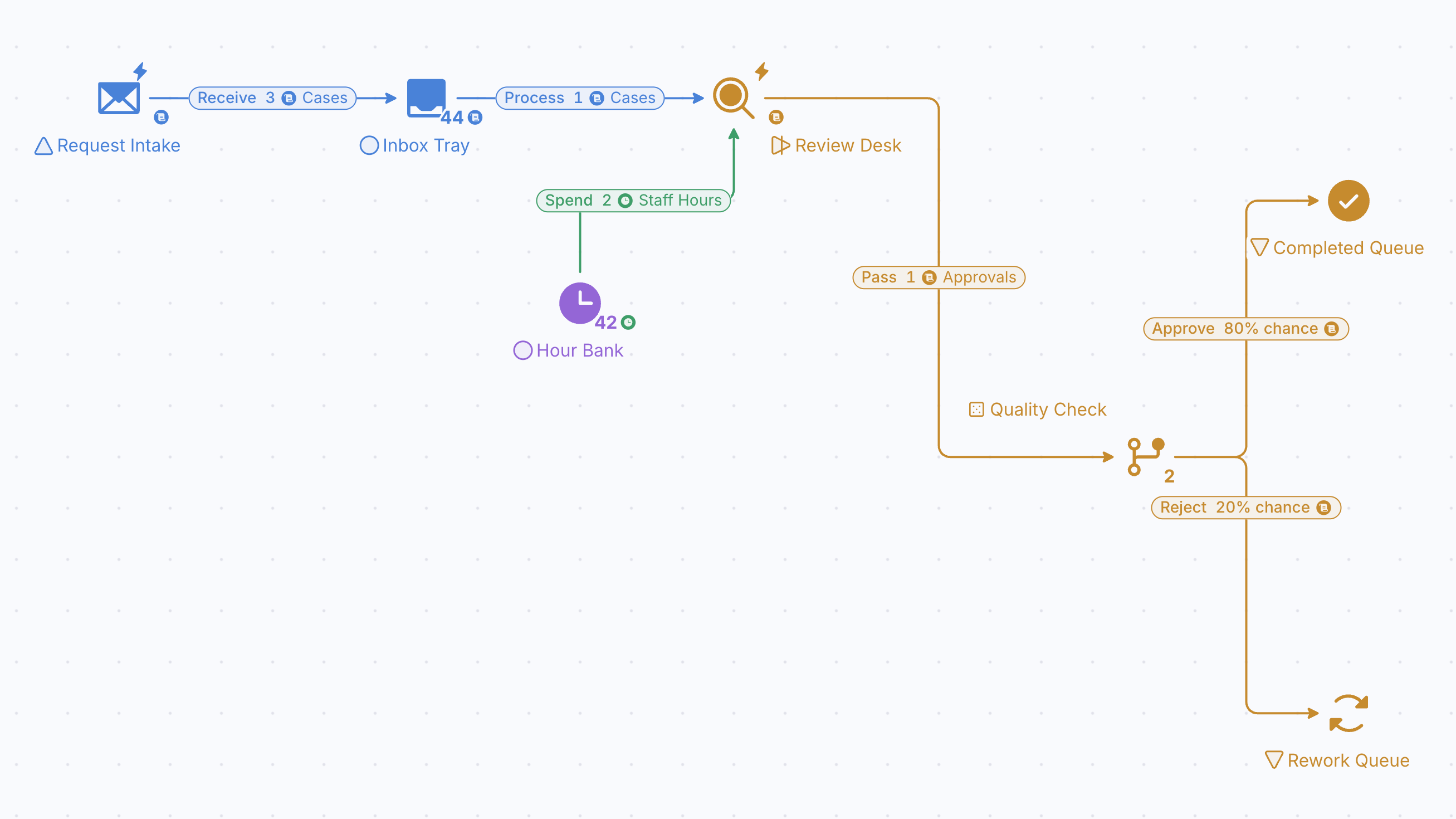
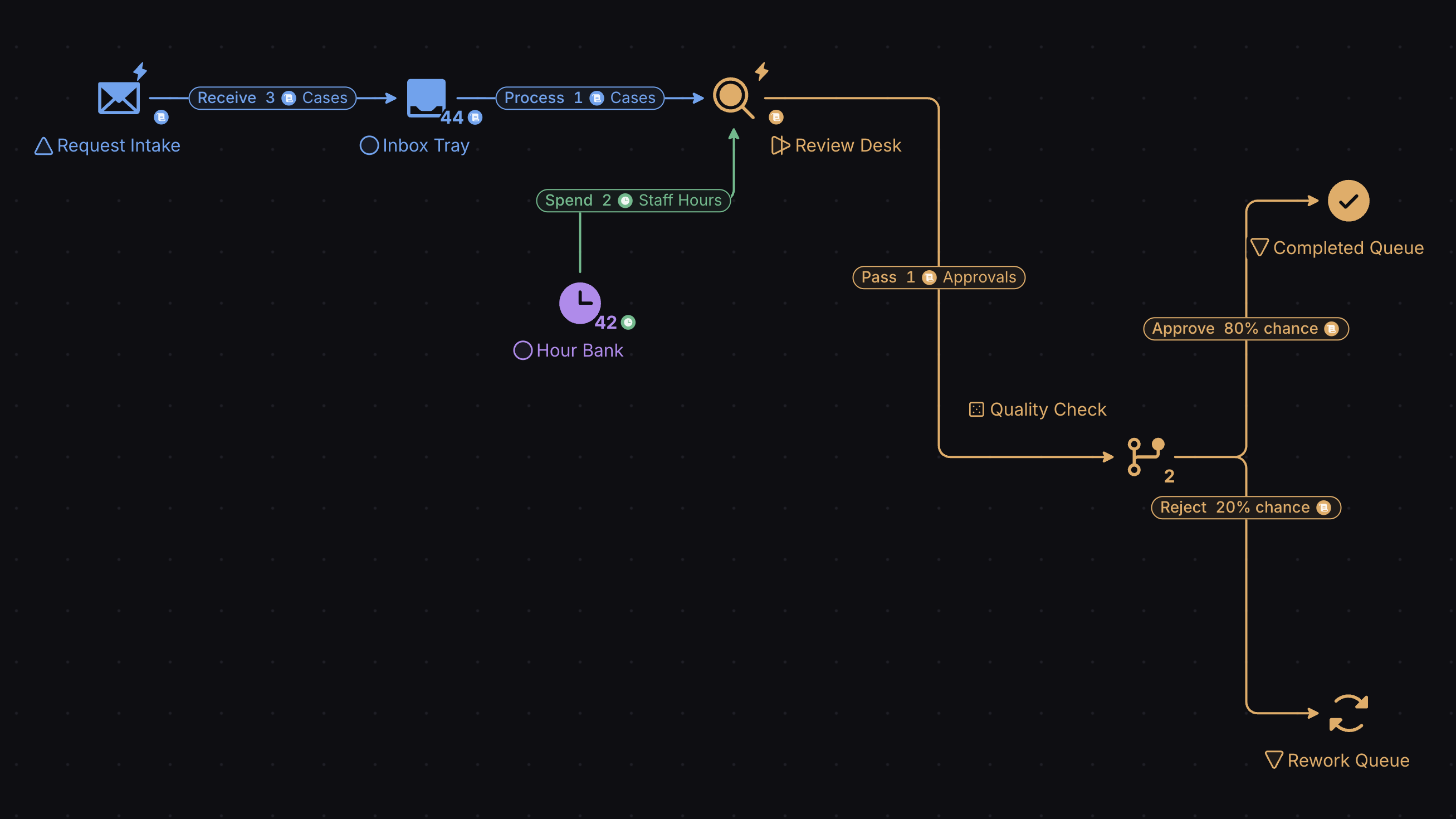
Teams that model with Machinations






Model, visualize, analyze, and fine-tune your business processes for maximum efficiency and performance
Design
Create playable diagrams for any system, regardless of complexity. Make feedback loops and economies easier to validate, communicate and understand.
Predict
Gain data-driven insights by employing out-of-the-box Monte Carlo simulations. Test what-if scenarios and measure their impact in a safe, virtual environment, with one click of the button.
Balance
Move the Levers of a model, Forecast what each change does and compare the Outcomes of every Scenario, so a system is balanced on evidence rather than trial and error.
What you can do with it
Process modeling
Draw activities, decisions and resource flows, then simulate scenarios to find bottlenecks.
Performance monitoring
Track process KPIs and adjust in time.
Process automation
Find the repetitive tasks and manual steps worth automating to cut human error.
Risk analysis
Simulate risk scenarios to find weak points and keep operations running.
Customer journeys
Map the journey across channels to find touchpoints and pain points.
Compliance management
Model regulatory requirements and compliance workflows to avoid penalties.
Business process automation in customer support
One of the most efficient Business process management (BPM) procedures is utilizing Business process automation.
BPA takes advantage of a variety of advanced technology, including automation tools, process intelligence capabilities, and cloud platforms that improve efficiency and reduce human error.
The scope of the presented diagram is to visualize the effectiveness of automatic processes compared to manual repetitive interventions, in a particularized business process: Customer support.
The customer experience is becoming more and more critical for companies wanting to foster a positive and lasting relationship with their customers. As such, the customer support process must be streamlined and structured to identify and resolve gaps, bottlenecks, chaotic steps, or major inefficiencies.
The first step of a BPM lifecycle is to design the process by visualizing the components on a diagram. For this simulated customer support process, we can define the system’s inputs, constant values, and parameters:
- one diagram step represents one minute in the simulation;
- there are two simulated CS employees, represented by the purple and pink components;
- the frequency of the customer requests depending on their method of contact:
- integrated chats / contact forms / direct mail – registered every 10 to 15 minutes;
- phone calls / online meetings – registered – registered every 10 to 20 minutes;
- the ratio of different types of requests: 50% product questions, 25% defect reports, 25% sales requests;
- the time for a CS employee to process requests based on the contact platform:
- call requests are processed in 10 and 15 minutes;
- chat requests are processed between 5 and 10 minutes;
- the time for a request to be reassigned and closed based on type:
- 3 minutes to complete product questions;
- 5 minutes to complete defect reports;
- 10 minutes to complete sales requests;
Using the collected data, the next step can be started: modeling your process using a Machinations diagram. The diagram uses automatic sources that generate request types based on the given frequency of contacts. The frequencies are saved as custom variables: chat_freq and call_freq which can be reused for scalability and can be easily modified to be adaptable for models with different inputs.
Once a request enters the system, the customer support team will process the requests according to the method of contact. The CS team is simulated using a delay + gate system (pink and purple components) that halts the resource transfer for a specified number of minutes, representing the duration of a conversation.
As soon as a request is processed, the CS employees will sort the conversations based on the category of request: product question, defect report, sales request, and reassign the conversation to the adequate team. This behavior is represented by groups of delays that introduce the waiting time for re-assigning and completing the request.
Finally, we can register the time it took for the CS team to open, process, reassign, and close requests, creating a register that displays the total waiting time for all customers.
Running multiple Monte Carlo simulations using Machinations predictions we can gather the following relevant information: In two hours simulated, for 17 opened requests the mean waiting time for all customers is 394 minutes. Moreover, in the allocated time frame the CS team could complete only 12 out of the 17 active requests.
Once the inefficiencies have been identified, the third step of the BPM lifecycle can be started, improvement implementation. For this scenario, the adopted improvement is adding an automated chatbot for the processing phase of the pipeline. The chatbot is represented by an automatic gate that instantly greets customers and filters their requests based on type. After the chatbot sorts the requests the re-assigning process is kept unchanged.
Performing predictions using the newly added chatbot we can observe the improvements added to the BP. Using the same 17 requests registered during two simulated hours, the chatbot completed 15 requests and the total waiting time dropped to 140 minutes (254 minutes less than the CS team)
Find the waste before you redesign the process
Model each step, queue and hand-off, then Play a busy week and compare the cycle time of every redesign.
- ISO 27001 certified
- SSO & SAML
- GDPR compliant
- Trustpilot verified
- Red Herring Top 100
- Dealroom Rising Star