Charts
Charts plot selected values as you Play a model. Compare pools or registers over steps, inspect possible outcomes and see how their values relate.
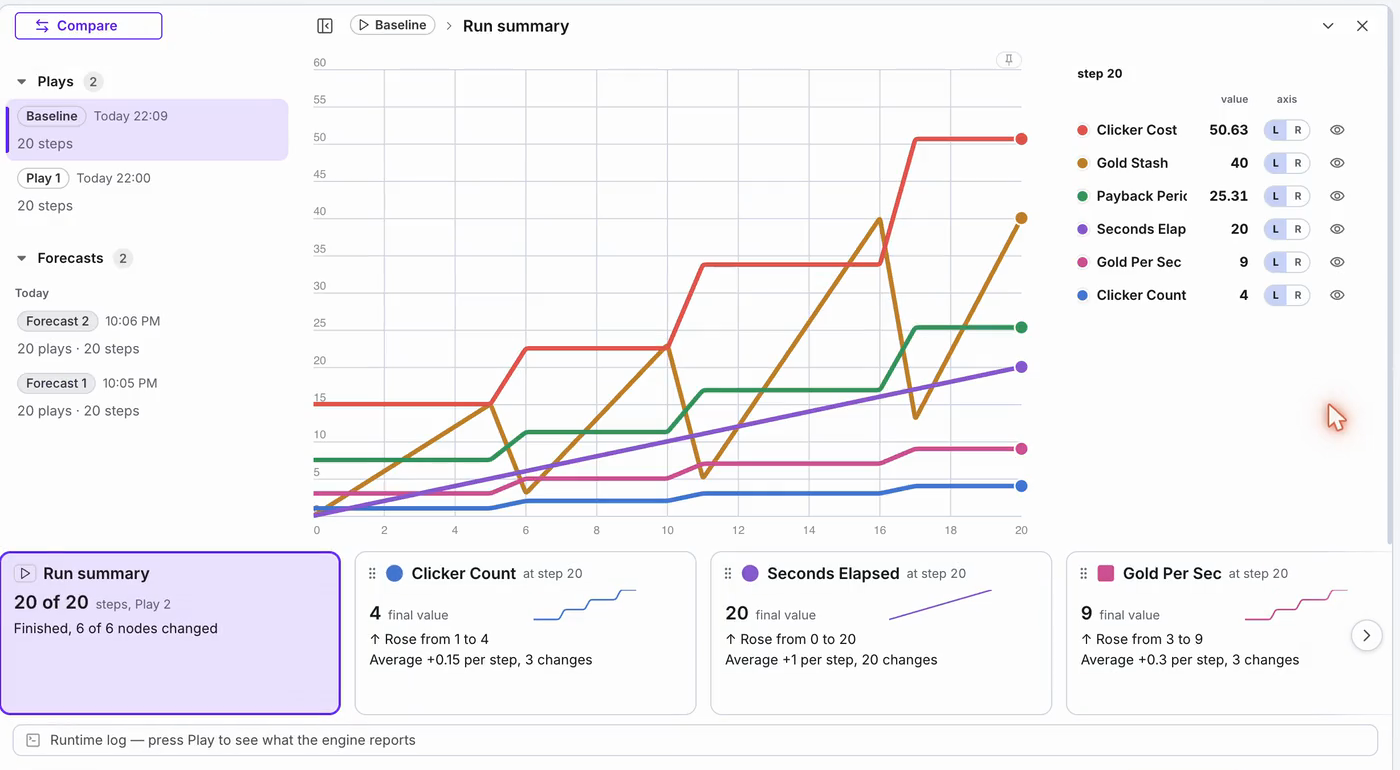
To open the chart, click a chart card under the canvas. The chart panel lists your Plays and Forecasts on the left, in the card of each scenario, and shows the chart with a table of the plotted nodes: each row has the value at the chosen step, an axis switch (L or R) and an eye to show or hide the line.
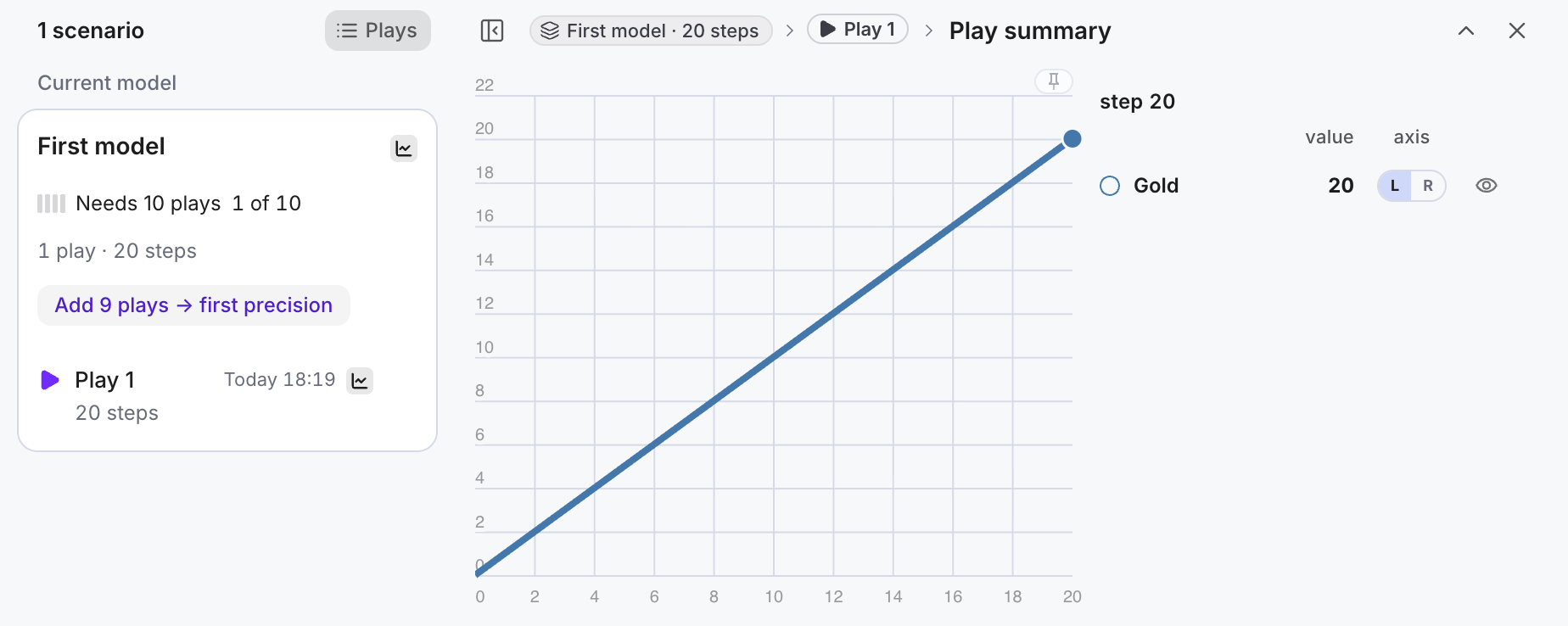
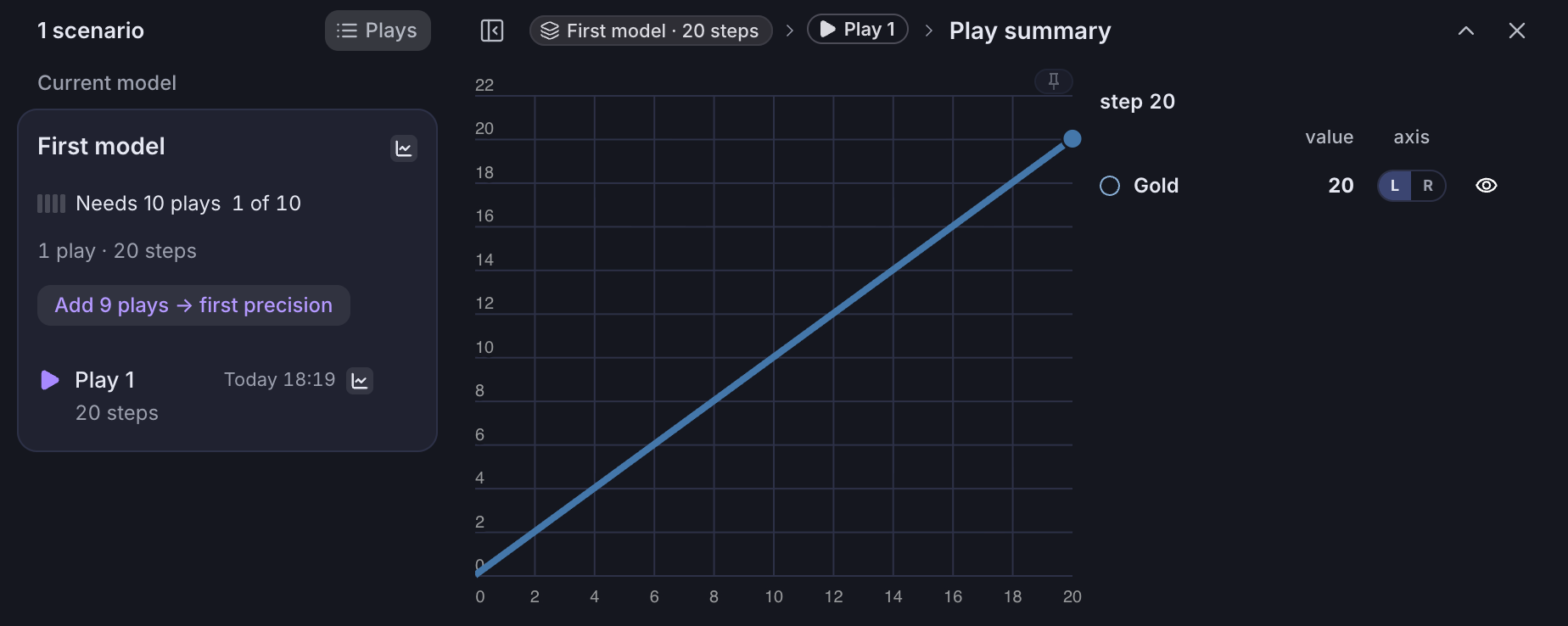
Some of the older recordings and screenshots further down this guide still show an earlier editor. The text explains chart concepts; check the current app for the latest controls and placement.
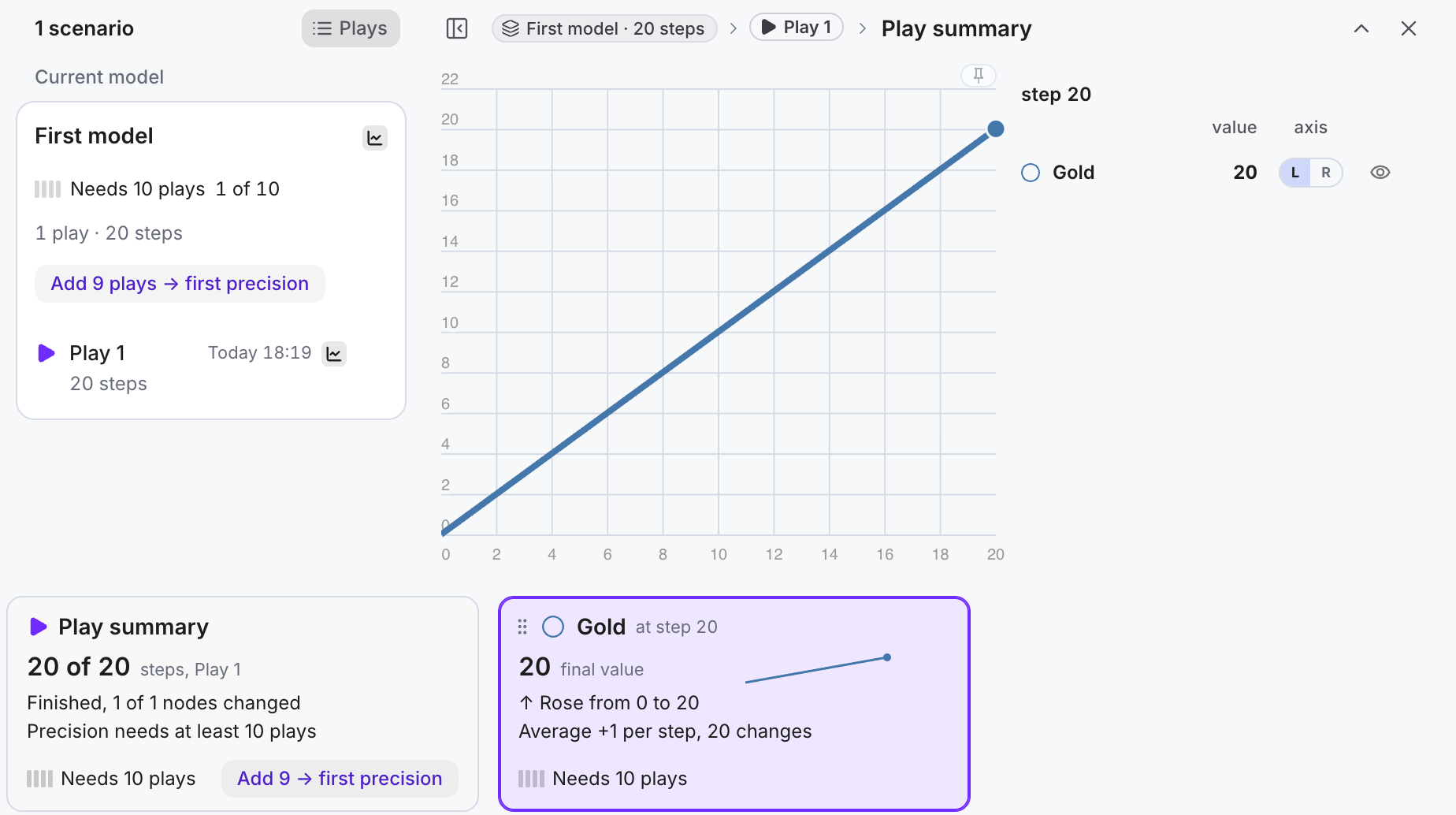
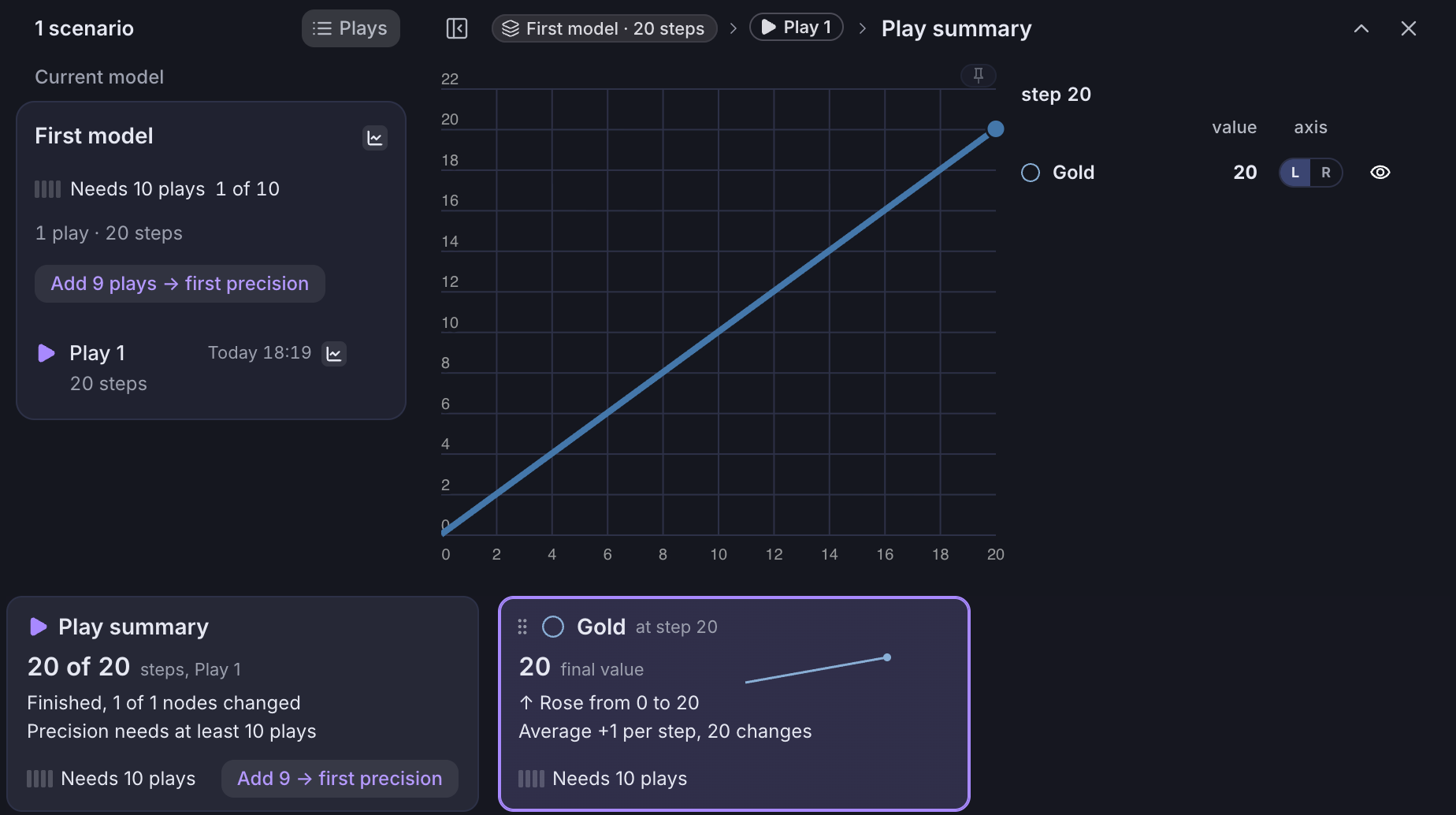
Plotting Nodes
- Select the Nodes (Pools or Registers) you want to plot
- Switch on Outcome at the top of the Properties panel. New Pools and Registers have it on already.
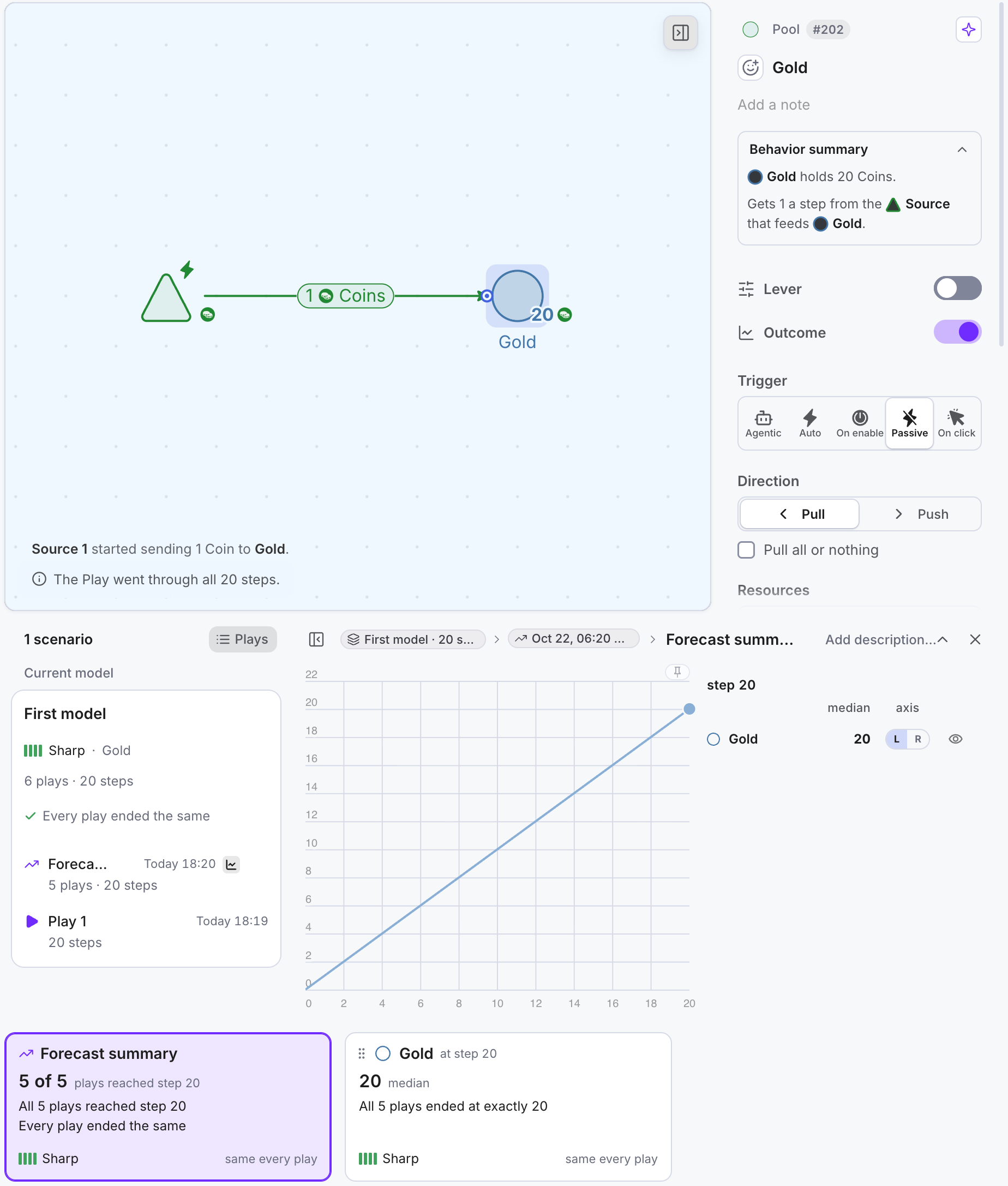
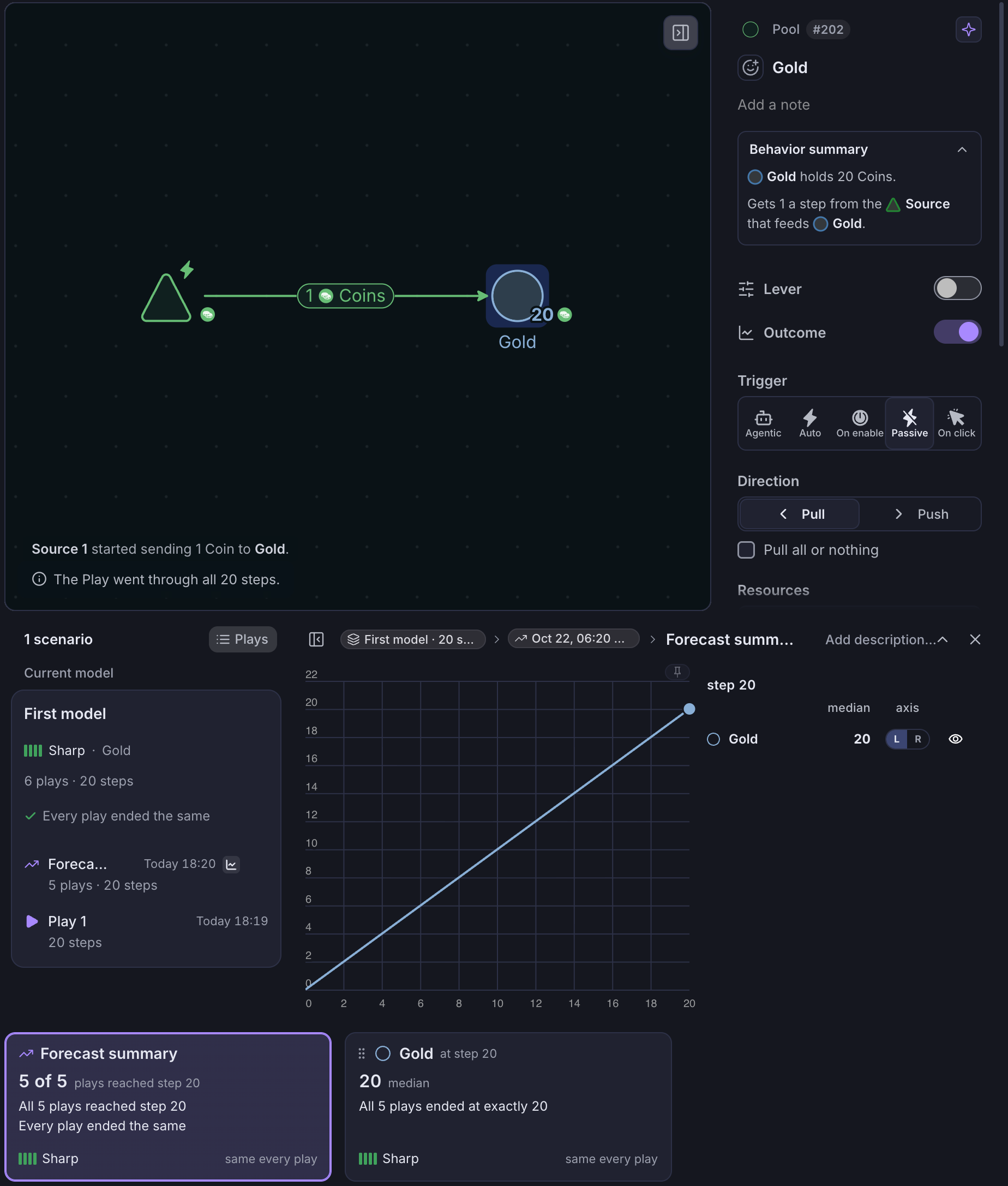
To remove a Node from the chart, select it and switch Outcome off in the Properties panel. (In the right-click menu the same choice is called Track in charts.) To keep it plotted but hide its line for a while, press the eye at the end of its row in the table on the right of the chart.
Context Menu
Each plotted Node is a row in the table on the right of the chart. In the current editor a row has no right-click menu; everything you can change sits on the row itself:
- The line color is the color of the Node itself, set with the color control on the floating toolbar above the selected Node, not the color of the Resources it processes. A Pool, for example, may contain Resources of different colors.
- The scale, left or right – the L and R switch in the axis column puts the line on the left or the right scale. This is particularly useful when the data series you are plotting have different magnitudes (= number range). E.g.: the number of coins (large range of numbers) plotted against each level (smaller range of numbers).
- Visible or hidden – the eye at the end of the row.
- Highlight – while you hold the pointer over a row, that Node’s line is highlighted and the others fade.
To better understand the difference between Pool and Resources colors, read more about it in the Filter (Color Coding) article.
On the y-axis Machinations plots the values of the selected Pools and Registers.
The x-axis represents the number of Steps executed.
Indicators: Mean, Median, Min & Max
To aid with your analysis, a Forecast summarizes many Plays of the same model. Select a Forecast in the Forecasts list, left of the chart: the table then shows, for every plotted Node and the chosen step, the statistics of all its plays (max, p99, p95, med for the median, mean, p5 and min) instead of the single value of one Play, and the Play summary card under the chart says how many of the Forecast’s plays reached that step. When the plays differ, the Fan chart draws the median as a line with two bands around it, a darker one for the middle half of the plays (P25 to P75) and a wider one for 90% of them (P5 to P95), while the Line chart option draws one line per statistic instead, and the cards show how far the plays spread; when they all end at the same value, the card says so, for example “All 50 plays ended at exactly 2K”.
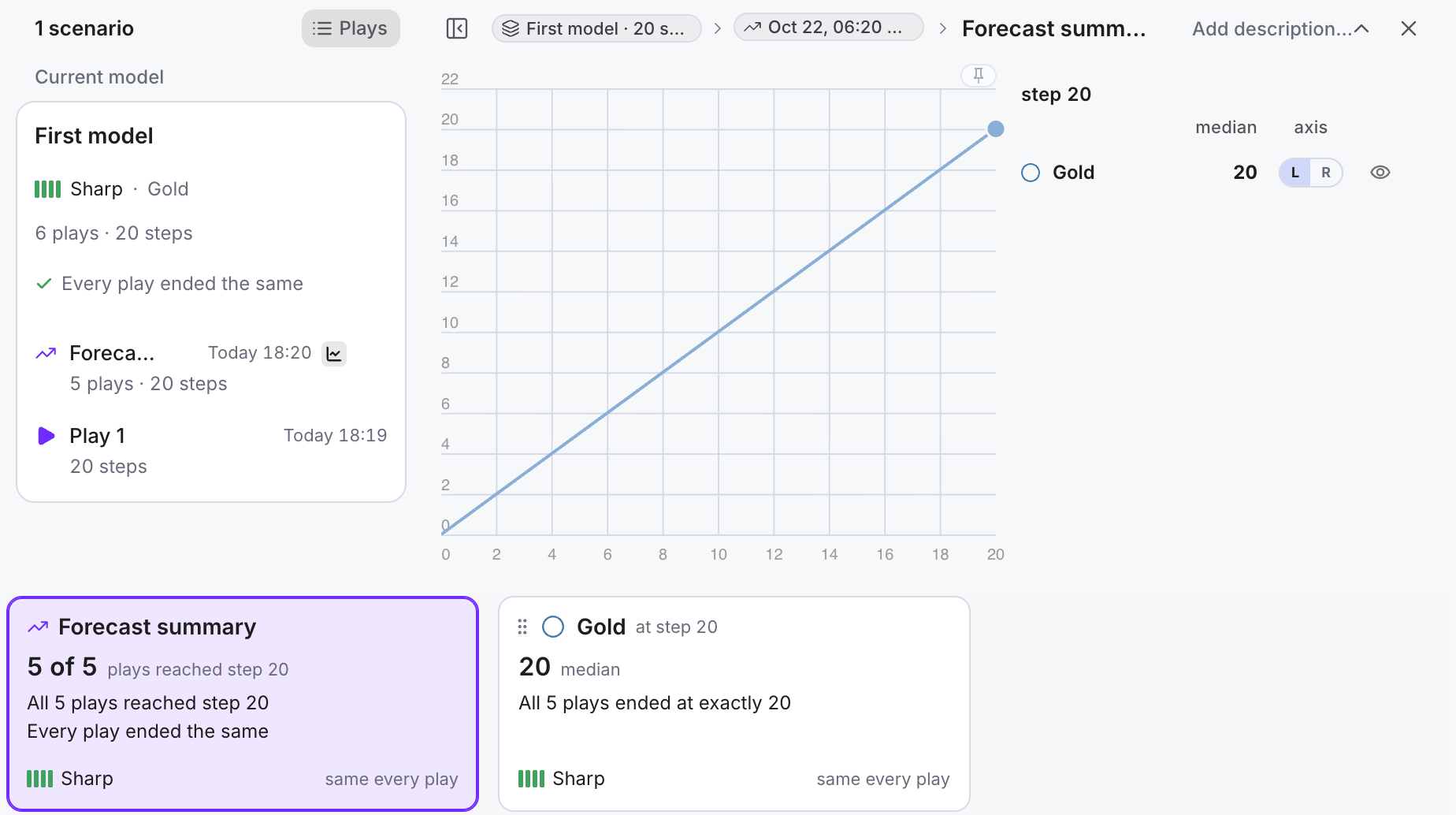
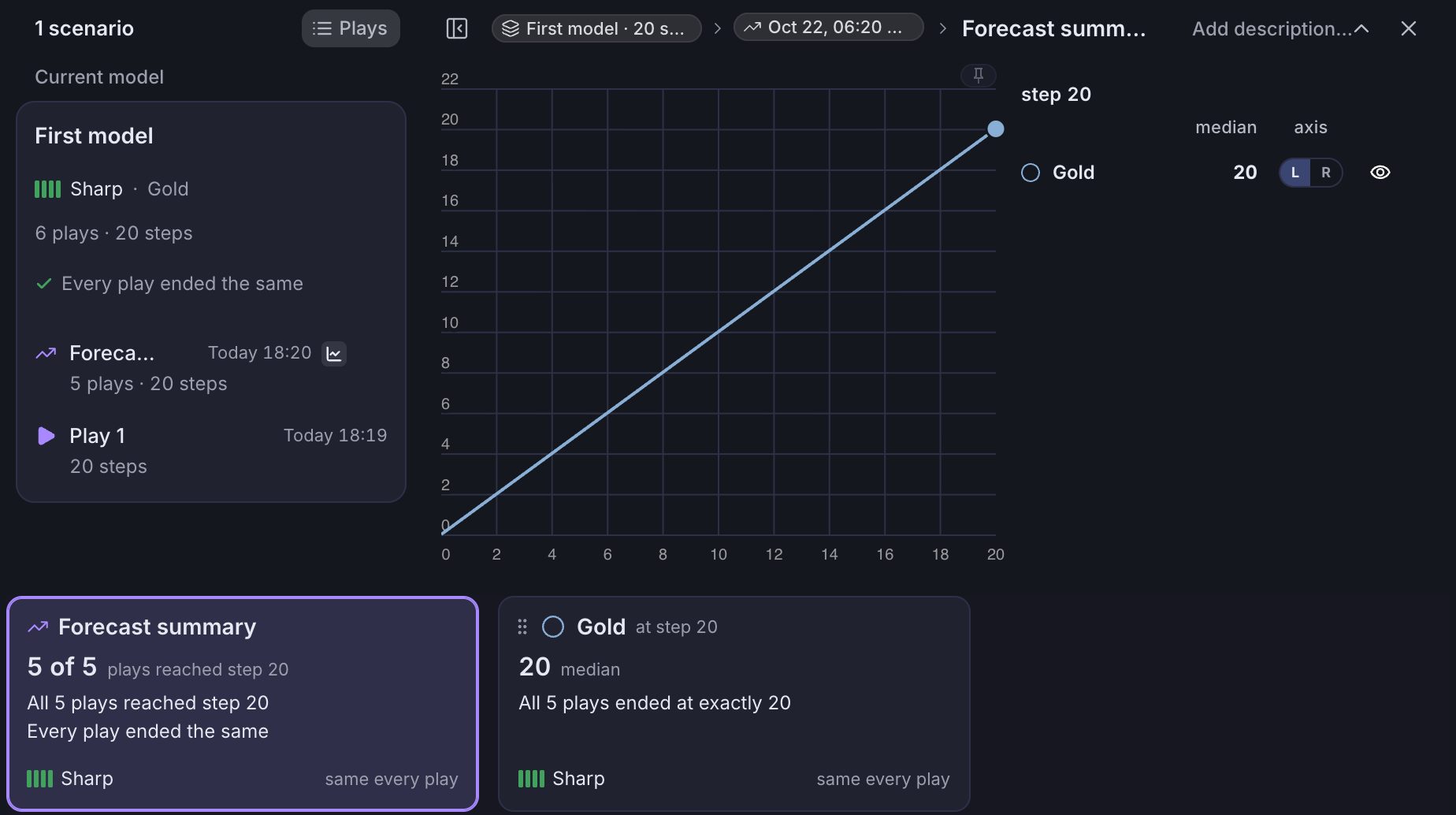
A model that ends at the same step, with the same values, in every Play shows a band of no width: the median and the min-max range are then the same number.
How are averages calculated?
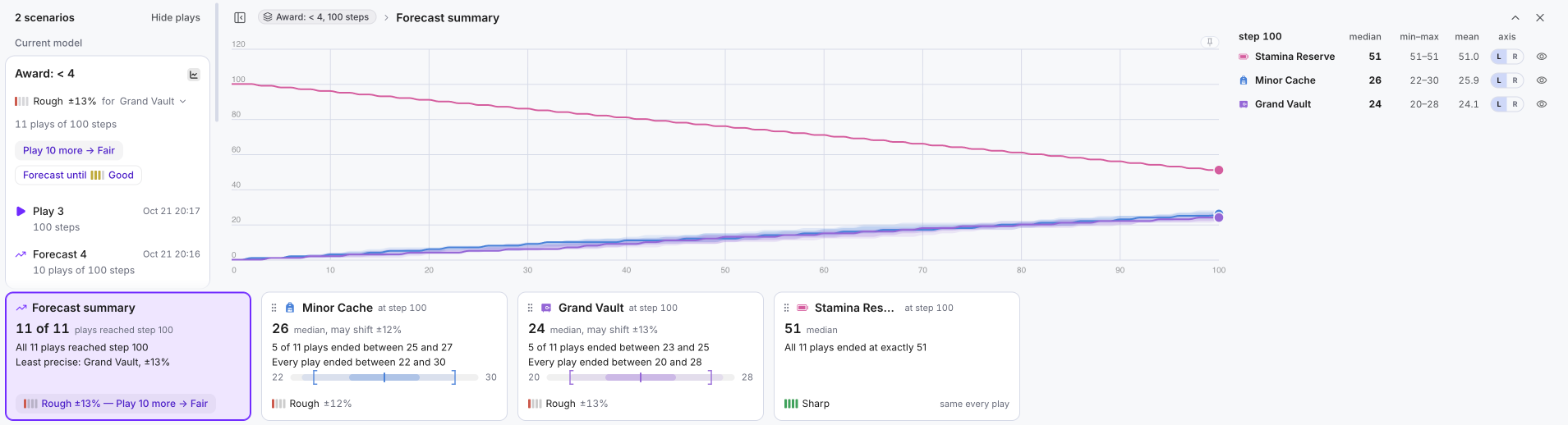
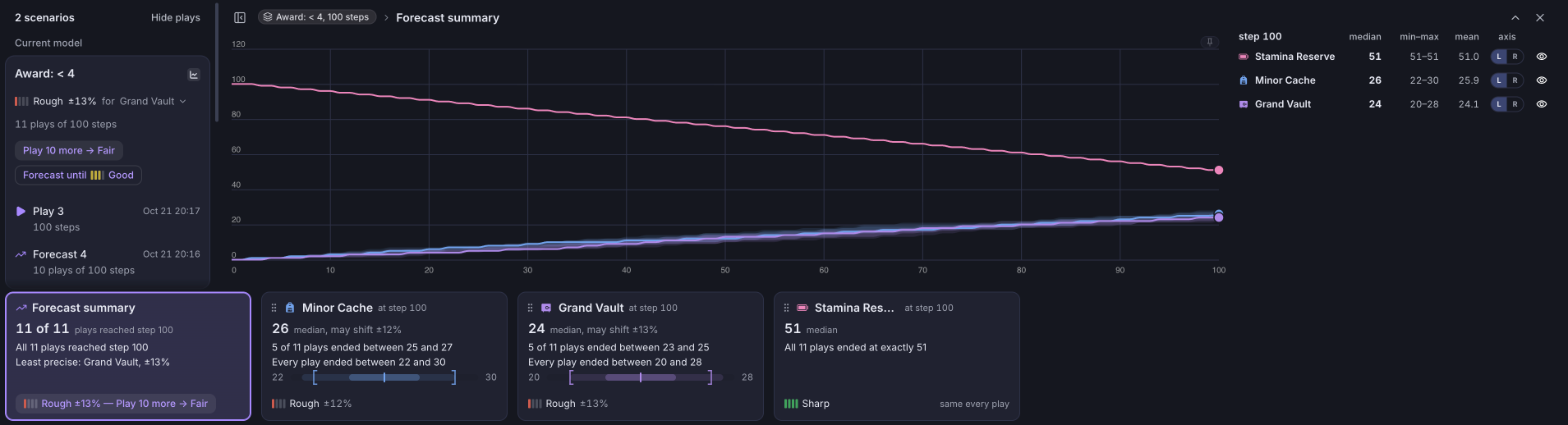
In the current editor the table of a Forecast (at the right of the chart in the picture) lists, for the chosen step, the median, the min-max range and the mean of each plotted node, and it can show the p5, p95 and p99 percentiles as well. The picture is a different model from the Coin Points sample; the numbers in the list below are the recorded Coin Points example:
- The Mean: represents the Mean of the plotted Node’s values at a certain Step, across all numbers of Plays executed. For the “Coin Points” Pool example, 4340 is the Mean of all values the Pool reached at Step 39, across 10 executions.
- Mean calculation: the sum of all values, divided by the number of values. E.g.: The mean of a, b, c is (a+b+c)/3.
- The Median: represents the median value of all values of the plotted Node, at a certain Step. For the “Coin Points” Pool example, 4200 is the median of the values the Pool has gone through at each Step 39, across the 10 Plays.
- The Median is the value separating the higher half from the lower half of the data set. It may be thought of as “the middle” value.
- In your analysis, use the median in comparison to the mean, to check if your data set is not skewed by a small proportion of extremely large or small values. This comparison will provide a better representation of a “typical” value.
- Min/Max Values: The minimum/maximum values in the data set of the analyzed Node, at the same Step of multiple executions. In the example above: the Min and Max values represent the minimum and maximum values generated by the Pool at Step 39 of each of the 10 executions.
Pro tip – To see only one Play or Forecast, select it in the list, or hide the other lines with their eyes.
Distribution Filter
For a Forecast, the bars to the right of the chart show how the plays are spread at the chosen step: each bar is a range of values, and its length is the share of plays that ended in that range. Click a bar to select only those plays: the table switches to their statistics, the chip above it reads, for example, “1 of 5 plays selected”, and the chart band narrows to them.
The Bars menu at the top right of the chart sets the Shape (Distribution or Cumulative) and the Values (% of plays or Count).
- Click on the bar of the distribution range you would like to take a closer look at.
- Click the small cross on the “plays selected” chip to clear the selection and show all plays again.
Zoom
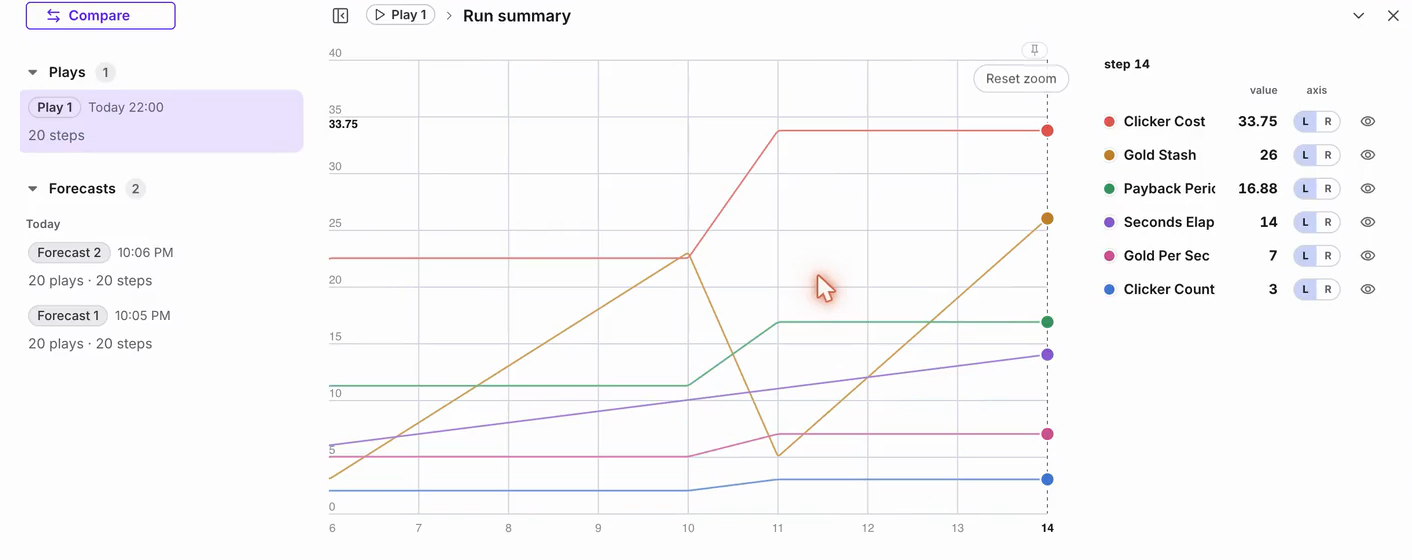
You can zoom in on a range of steps by dragging across the chart, from the first step to the last step you want to see. The step axis and the values on the right follow the range.
Move the pointer over the chart to read every plotted value at that step in the table on the right.
The Reset zoom button at the top right of the chart shows all steps again.
Change graph visibility
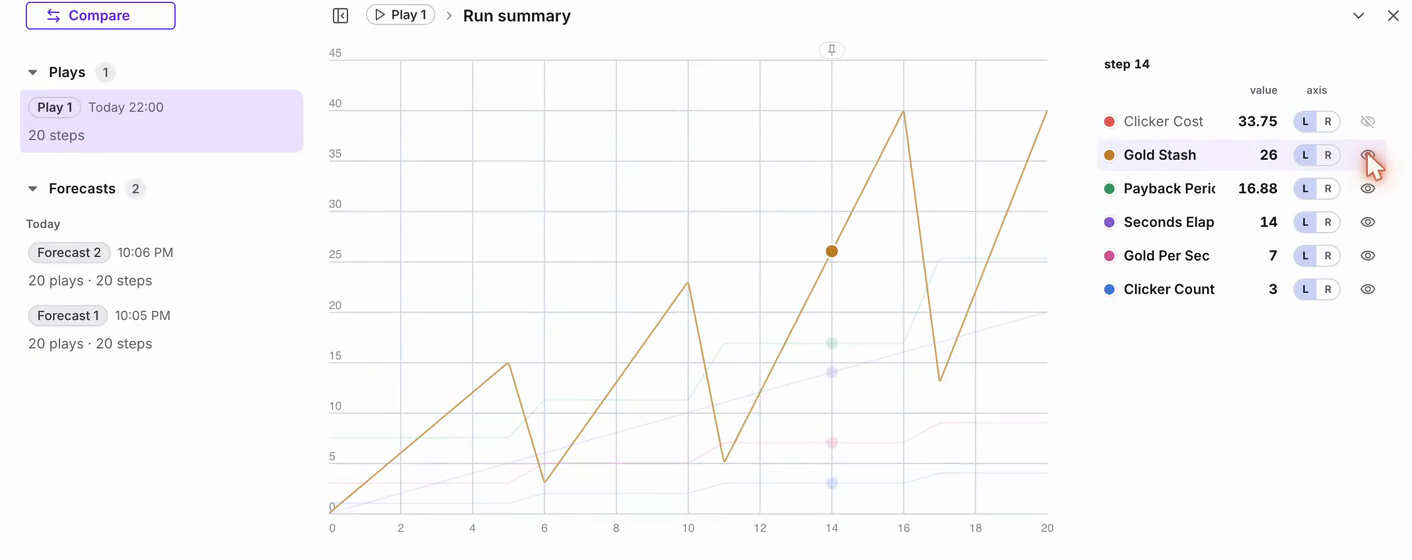
Every plotted node is visible by default. Click the eye at the end of its row in the table on the right of the chart to hide its line, and click it again to show the line. While you hold the pointer over a row, that node's line is highlighted and the others fade.
Organize your Interactive Plays & Predictions
Every Play and every Forecast is listed on the left of the chart panel, newest first, with a time stamp. A Forecast shows its progress as a percentage while it is running.
The list is grouped by Scenario: when you edit the model, your next Play starts a new scenario, and the earlier ones stay with the earlier model. Plays that were stopped early, or edited while they ran, go to the Sandbox, stay out of Forecasts and are cleared after 30 days. Tick the box beside another row to put it on the same chart and compare.
Click one in the list to show it on the chart. To remove a Play or a Forecast, open its options menu and choose Delete.
Multiple Charts
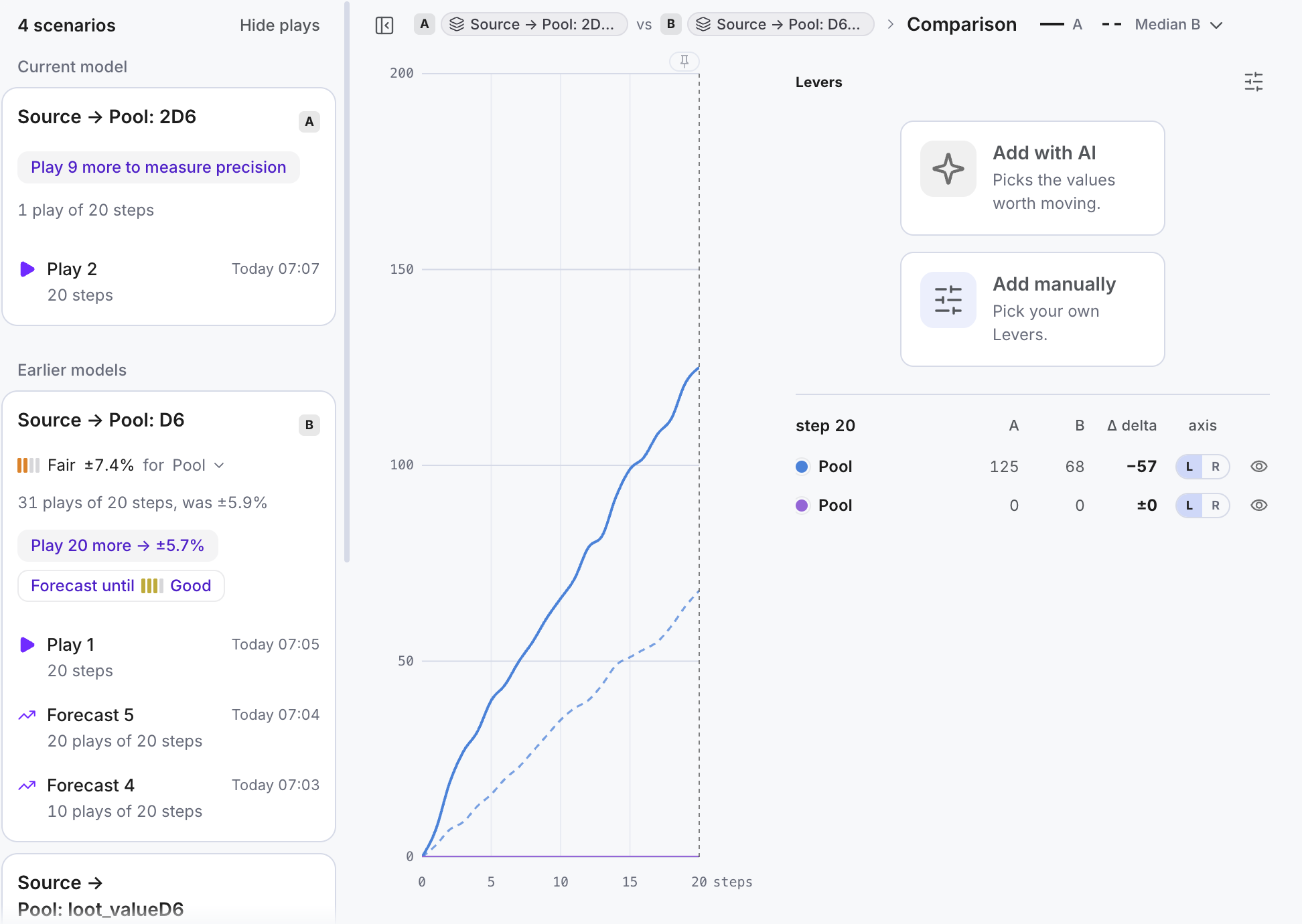
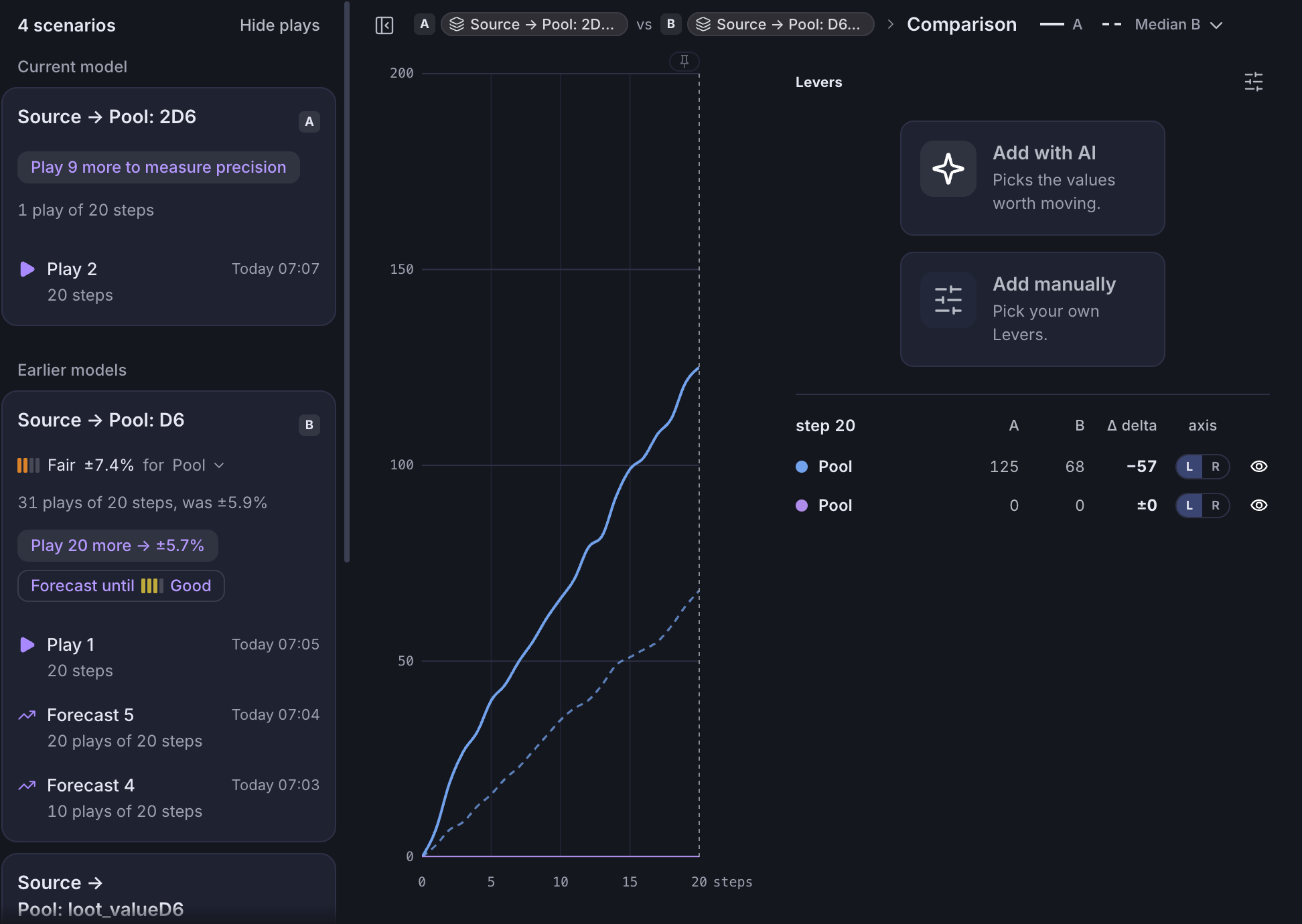
To put two Plays, or a Play and a Forecast, on one chart, tick the box beside each of the two in the list (its hint reads Compare with…). They are marked A and B, and the header reads “A vs B”. The line of A is solid and the line of B is dashed, and the table shows a column for A, one for B and a Δ delta column with the difference between them at the chosen step. Untick one of the two boxes to go back to a single chart.
Fullscreen Mode
Click the arrow at the top right of the chart panel to expand it over the canvas, so the chart and its value table get the whole height. Click the arrow again to shrink the panel back to the strip above the node cards.
Play History
Each Play and each Forecast you run is listed in the chart panel, under Plays and under Forecasts. The filter button of the earlier editor is not in the current one.
Interactive Plays are NOT saved from one session to the next.
If you are on one of our paid accounts, the Play History for shared diagrams is available for all people (on a paid plan) with whom you shared the diagram.
Options Menu for Predictions
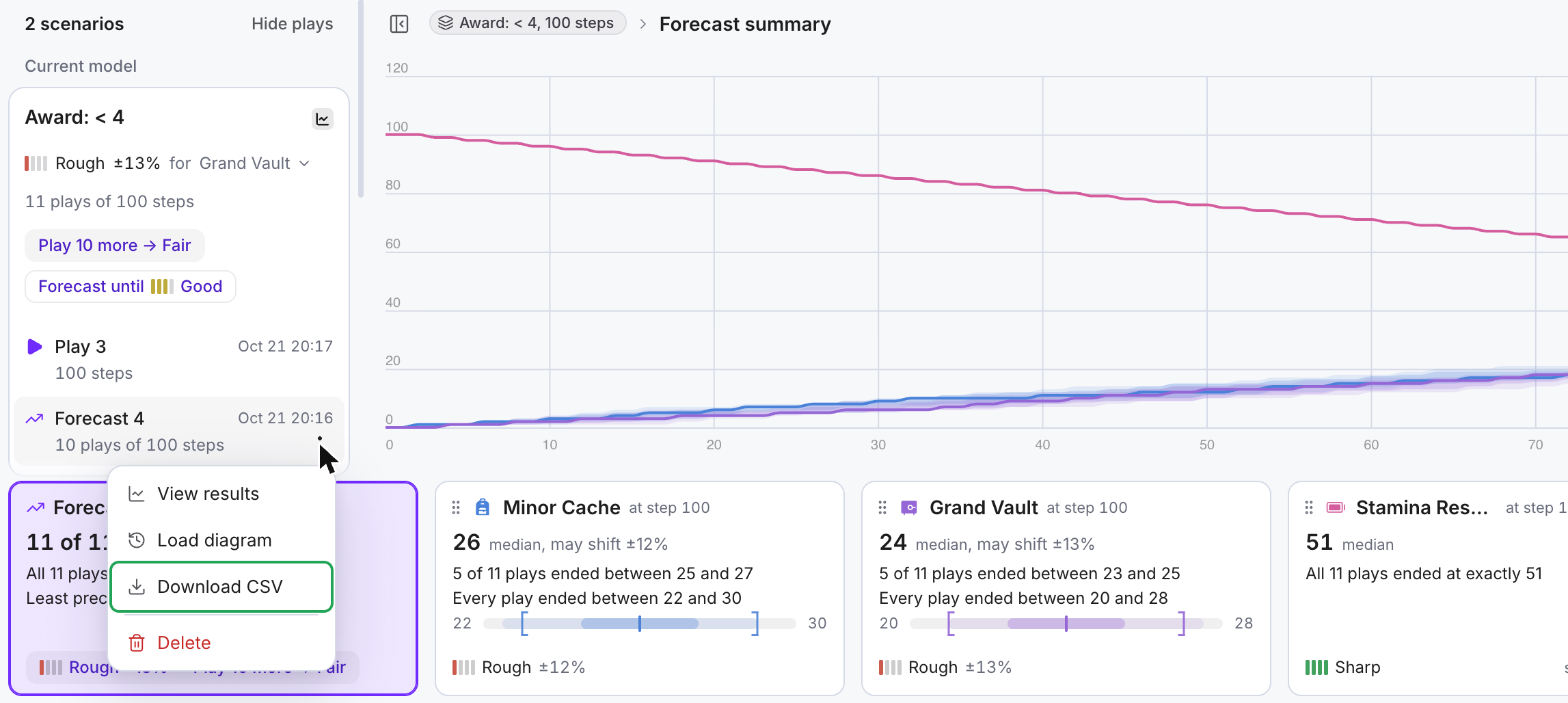
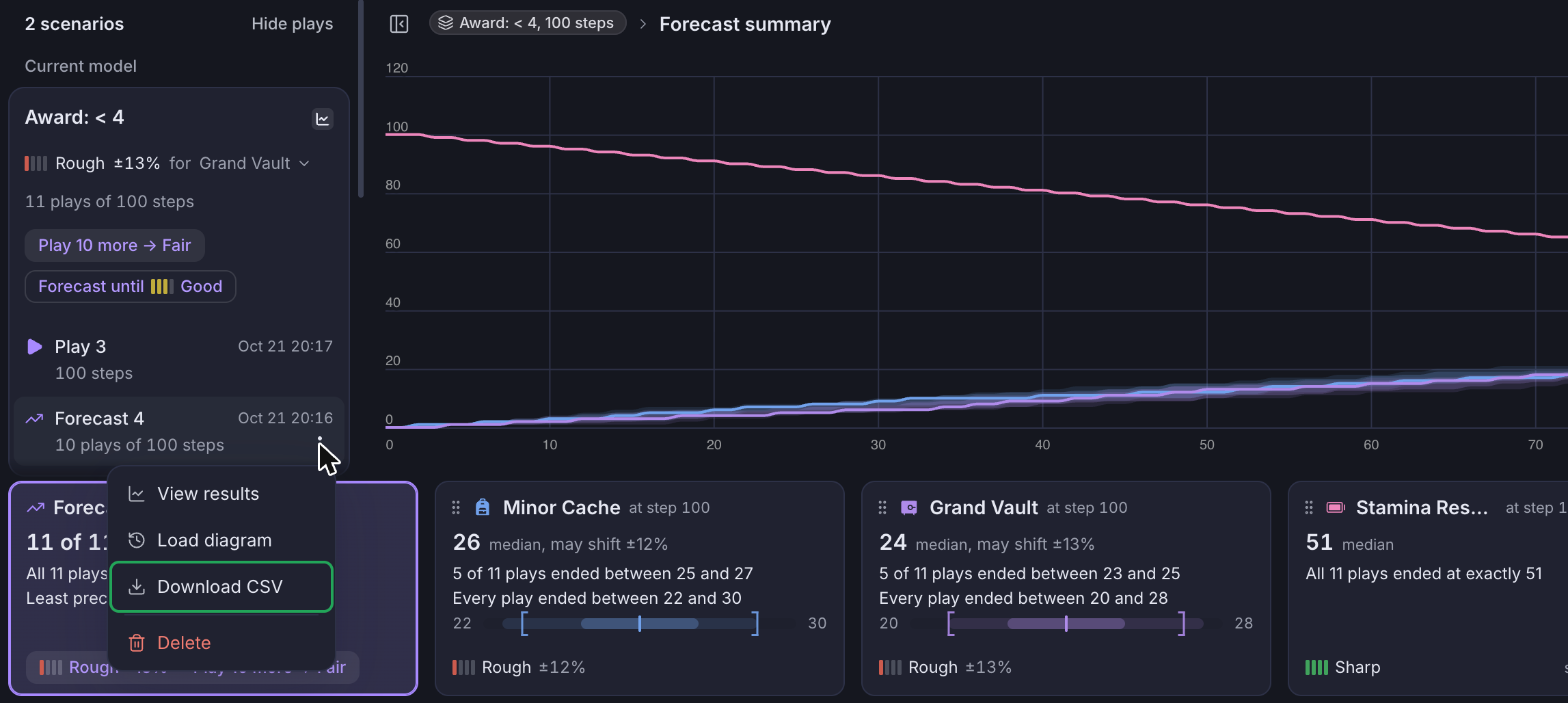
Hovering over a Play or a Forecast in the list reveals a 3-dot menu. Click the three dots to open its options menu.
From here, you can:
- View results – open its chart.
- Load diagram – bring back the diagram as it was when it ran.
- Download CSV – the values of the selected Play or Forecast as a table.
- Delete it.
Option Menu for Executions
In the current editor a Forecast is not broken down into single executions in the list: the Forecast is one item, with the options menu described above. Its chart shows the median and the min-max range of all its Plays together.
Exports
To export the results of a Play or Forecast, open its options menu and choose Download CSV: a table with the values of the simulation, broken down by Plays, Steps and Nodes. CSV is a Pro feature.
Selected models to Play and remix: Selected game economy models, Selected feedback loop models.