Converters & Traders
Converters

 Converters (V) are advanced Nodes in Machinations that convert one or more Resources into a specified output amount of Resources.
Converters model transformations such as raw materials becoming finished products, energy becoming output, or inputs becoming a service. They need at least one input and one output Resource Connection to function and will use only 1 Step to execute the conversion.
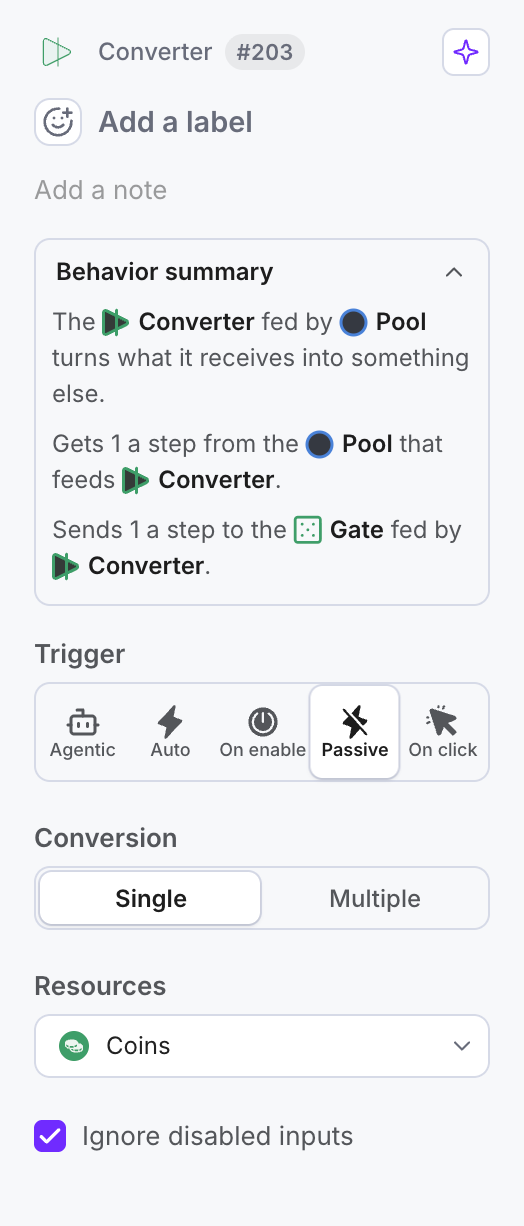
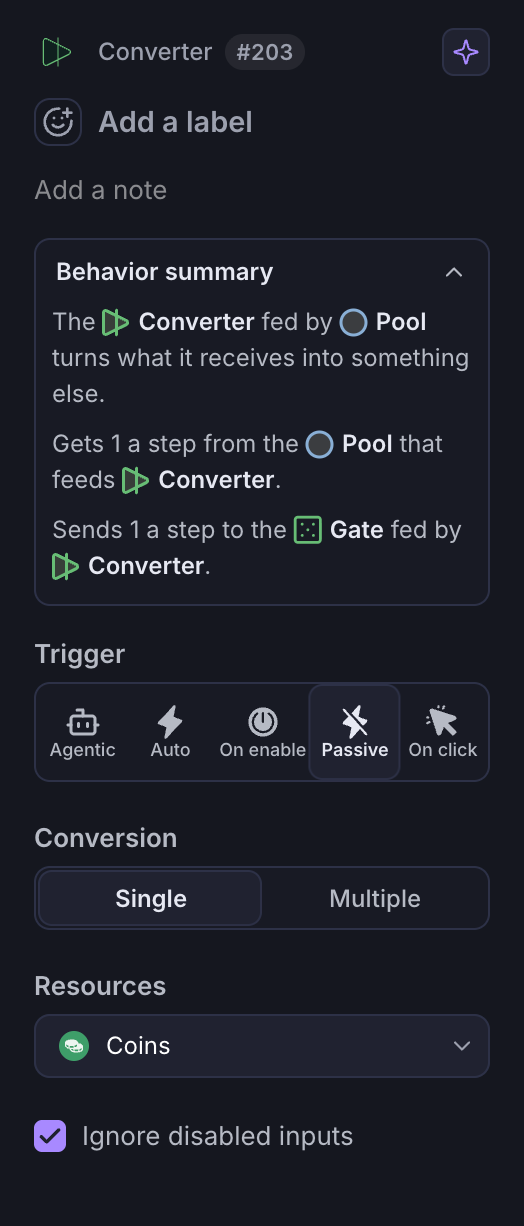
Select a Converter to adjust it in the Properties panel on the right: its label and note, Trigger, Conversion, Resources and the Ignore disabled inputs checkbox. Color and text style are on the floating toolbar above the node.
Like most other Nodes in a Machinations diagram, the Trigger of a Converter is a row of five buttons: Agentic, Auto, On enable, Passive and On click. Read Trigger Mode to see how each choice affects activation. A new Converter starts as Passive.
Example using a Converter
In League of Legends, you would use a Converter to forge a Hextech Key out of 3 Hextech key fragments.
Please hit the Play button in the example diagram below to see how it works.
The Converter will automatically pull 3 Resources every time step from the Key Fragments Pool and forge them into a Key. When there are not enough Key Fragments (3) to forge a Key, the Converter will continue to pull Resources (emphasized by the blinking Resource Connection) but will only succeed when the Pool contains at least 3 Key Fragments.
The rates at which Converters consume one type of Resource to produce another are determined by the Formulas on its input and output Resource Connections. In the example above, the Converter drains 3 Key Fragments and produces 1 Key. A small mark in the Converter’s corner shows the Resource type it makes.
Conversion
There are 2 types of conversions this Node can perform: Single or Multiple. You can set this in the Properties Panel > Conversion.
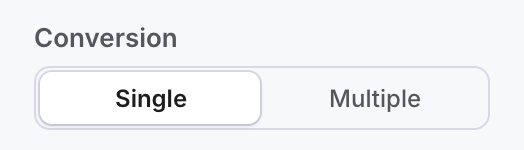
Single Conversion: Performs all possible conversions during separate Steps (one conversion per Step).
Multiple Conversion: Performs all possible conversions in a single Step.
Please perform a Step Play in the diagram above to see the difference between the two types of settings.
Disabled inputs on converters
Since converters allow multiple resource connections as their inputs, we needed to determine the converter’s behavior in the case one of the inputs is disabled. To set up the conversion rule when at least one input is disabled we can use the following checkbox found in the node’s properties panel: Ignore Disabled Inputs.
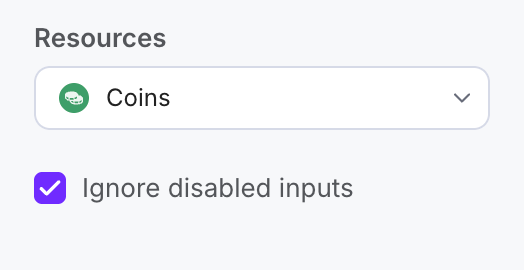
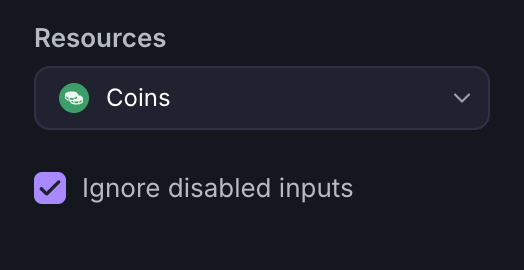
- Checked (default): The converter takes into account only the active inputs and performs the conversion, ignoring any disabled input;
- Unchecked: The converter takes into account all its inputs, active and inactive, and performs the conversion only when all branches become active;
In the attached example we can observe that the orange converter only performs its action when both inputs are enabled (change the bottom interactive register to any value >0). The green Converter that ignores disabled inputs will perform the conversion using only the active branch (the top one)
How to model converters using basic nodes
Converters act exactly as a Sink that triggers a Source, consuming one Resource to produce another. However, the Converter Node executes the conversion during ONE Step, as opposed to the equivalent construct, which requires 1 Step for each Node to perform its job.
Please take a look at the example below.
The Converter equivalent may be useful if you need to limit the conversion output.
By combining a Sink and a limited Source, you can get a limited Converter that can produce only a limited amount of Resources as its output.
Traders


Traders (X) are Nodes that cause Resources to change ownership when fired. For example, a buyer and seller can exchange two types of Resources.
Traders need at least two input and two output Resource Connections to function. They require that the two types of Resources being traded are differentiated through Filter (Color Coding). On the canvas, a Trader shows the two types it swaps as two small marks in its corner.
All input and output Resource Connections need to be color coded, too, even if one of the colors is the default color Black.
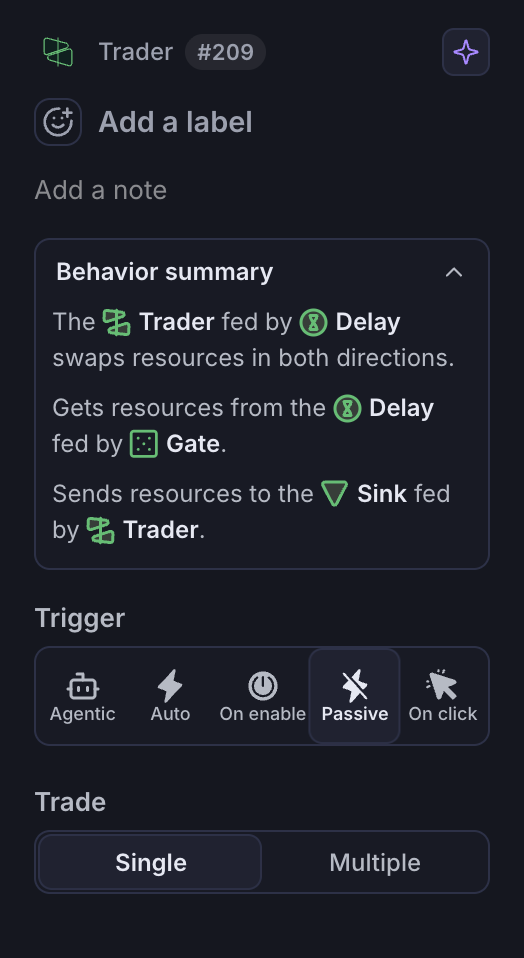
Select a Trader to adjust it in the Properties panel on the right: its label and note, Trigger and Trade. Color and text style are on the floating toolbar above the node.
Like most other Nodes in a Machinations diagram, the Trigger of a Trader is a row of five buttons: Agentic, Auto, On enable, Passive and On click. Read Trigger Mode to see how each choice affects activation. A new Trader starts as Passive.
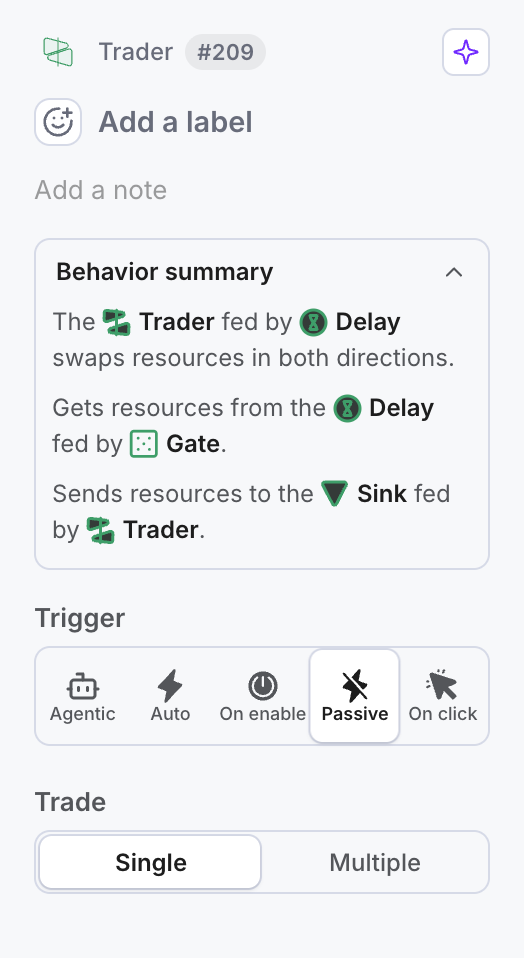
Use Traders when a given number of Resources of one type is exchanged for (not converted into) a given number of another type. This is ideal for any situation that resembles shopping: the merchant receives money, and the customer receives goods in a stated proportion (the price).
If the merchant or the customer does not have the necessary Resources, the trade cannot occur.
Example using a Trader
In the example below we have two pairs of input-output Resource Connections, each of a certain color (3 red coming in – 3 red going out; 2 blue coming in – 2 blue going out).
To filter Resources, tick “Filter” in the Properties of a selected Resource Connection. (The Filter box ticks automatically when choosing a different color than the default from the drop-down beside it.)
You can learn more about this in the Filter (Color Coding) article.
At a glance, Converters and Traders can seem similar: Resources enter a Node, and different Resources leave it.
In a model, however, they serve different purposes. When activating a Converter, Resources are consumed and produced; therefore, the total quantity of Resources in the system can change. In contrast, activating a Trader leads only to an exchange; each Resource type is transferred rather than created or destroyed in this example.
More on Converters and Traders:
Selected models to Play and remix: Selected game economy models.