Trigger Gates
Trigger Gates trigger the action of another Node on the diagram.
Trigger Gates use State Connections for Outputs, and have NO Input Resource Connections.
Trigger Gates support all five Trigger Modes (Agentic, Auto, On enable, Passive and On click) and also support external trigger inputs.
Depending on its Distribution (Deterministic or Random) and the Type of its output State Connections, Trigger Gates will activate other Nodes.
Trigger Gates use State Connections of Type Trigger, Trigger if or Split trigger as outputs. Split trigger chooses which output fires, using the chance or weight written on each connection.
Every time a Gate performs an action, the target of the Trigger is activated.
The examples below show how Trigger Gates distribute activations.
Deterministic
Deterministic Trigger Gates with numeric Formulas
A Deterministic Gate with no input and one or more State Connections as outputs, for which the Formulas have numeric values.
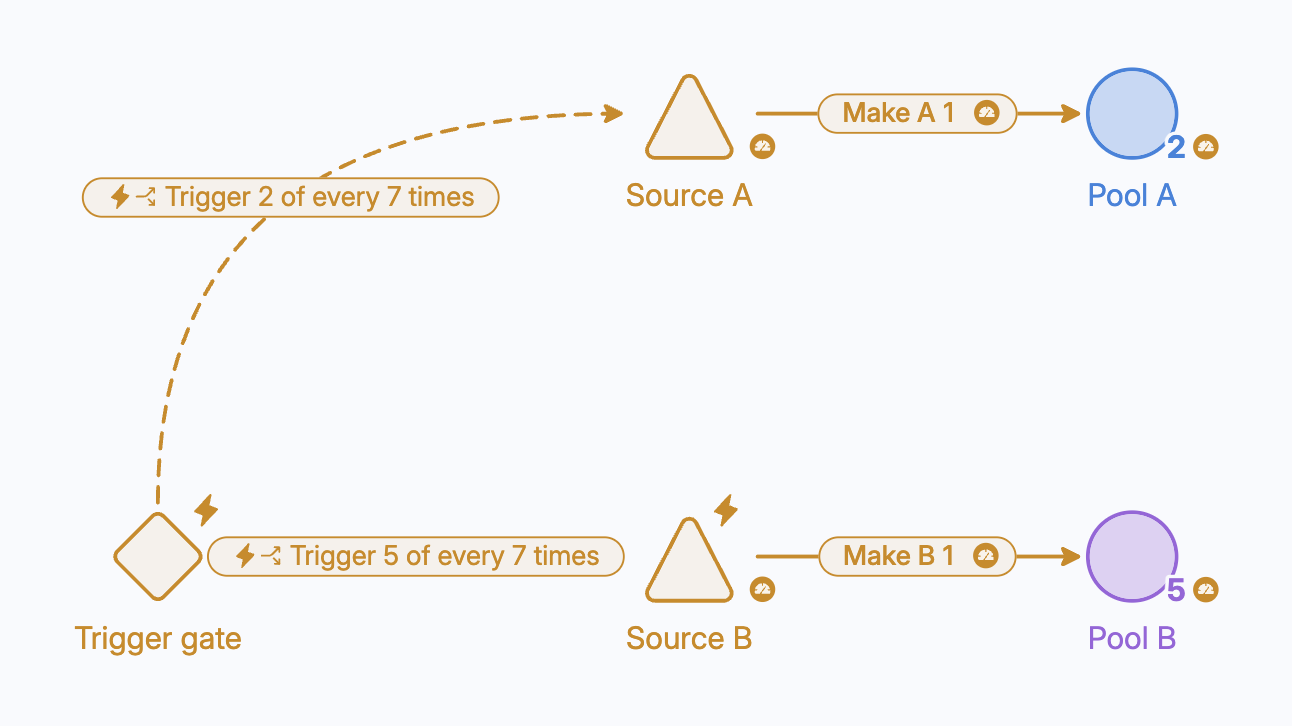
Each Step, the Gate sends one trigger. Over a cycle it activates the Sources as many times as the number on their State Connection says, and the labels read Send 2 of 7 and Send 5 of 7. The order in which the cycle starts is determined by which branch was first added to the diagram. As such, the Source on the upper branch is activated first, twice, one activation per Step. The Gate then continues with the second Source added and activates it five times. After 7 Steps the cycle starts again.
Deterministic Trigger Gates with conditional Formulas
A Deterministic Gate with no input and one or more State Connections as outputs, for which the Formulas have conditional values.
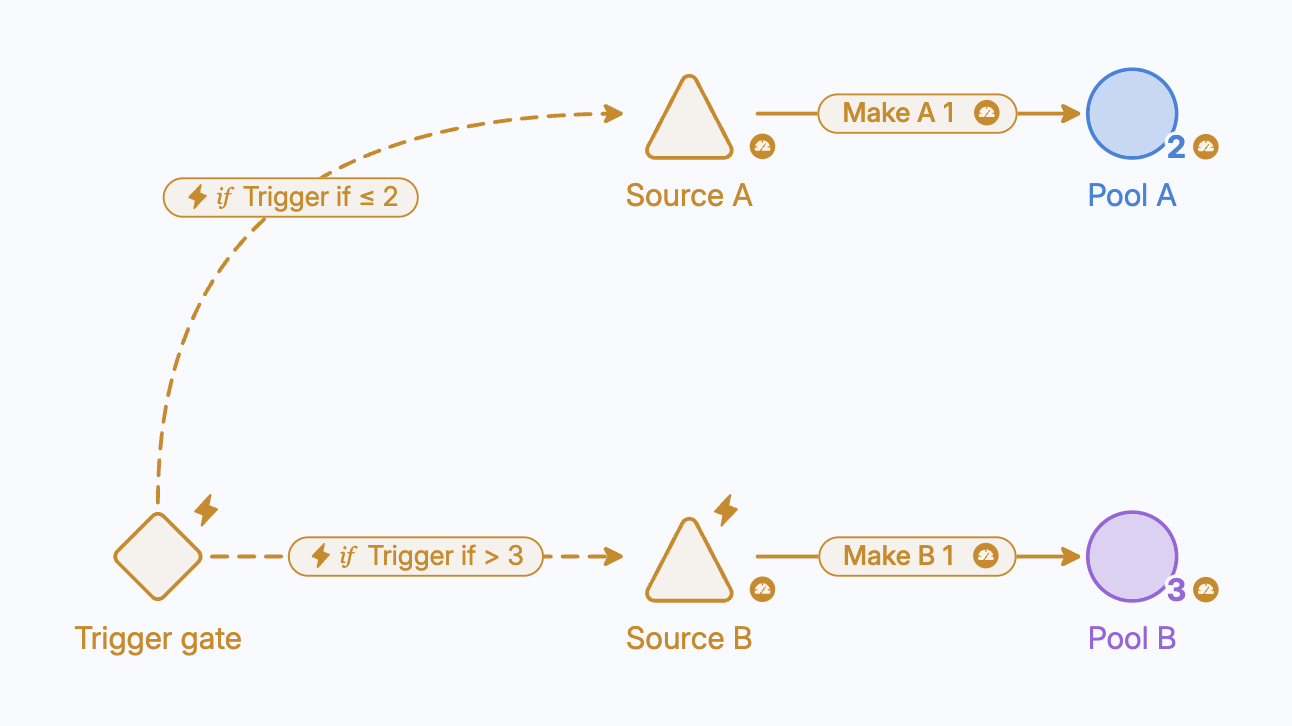
The Gate counts the number of Steps and activates the Source for which the number of the steps meets the condition. It must be noted that this type of gate takes into account the Play’s step count.
Here’s what happens in the example above:
- For steps between 1 and 2, it activates the upper branch
- Step 3 doesn’t meet any of the conditions, so it’s skipped
- for Steps >3, it activates the lower branch
Deterministic Trigger Gates with Percentage Formulas
A Deterministic Gate with no input and one or more State Connections as outputs, for which the Formulas have Percentage values.
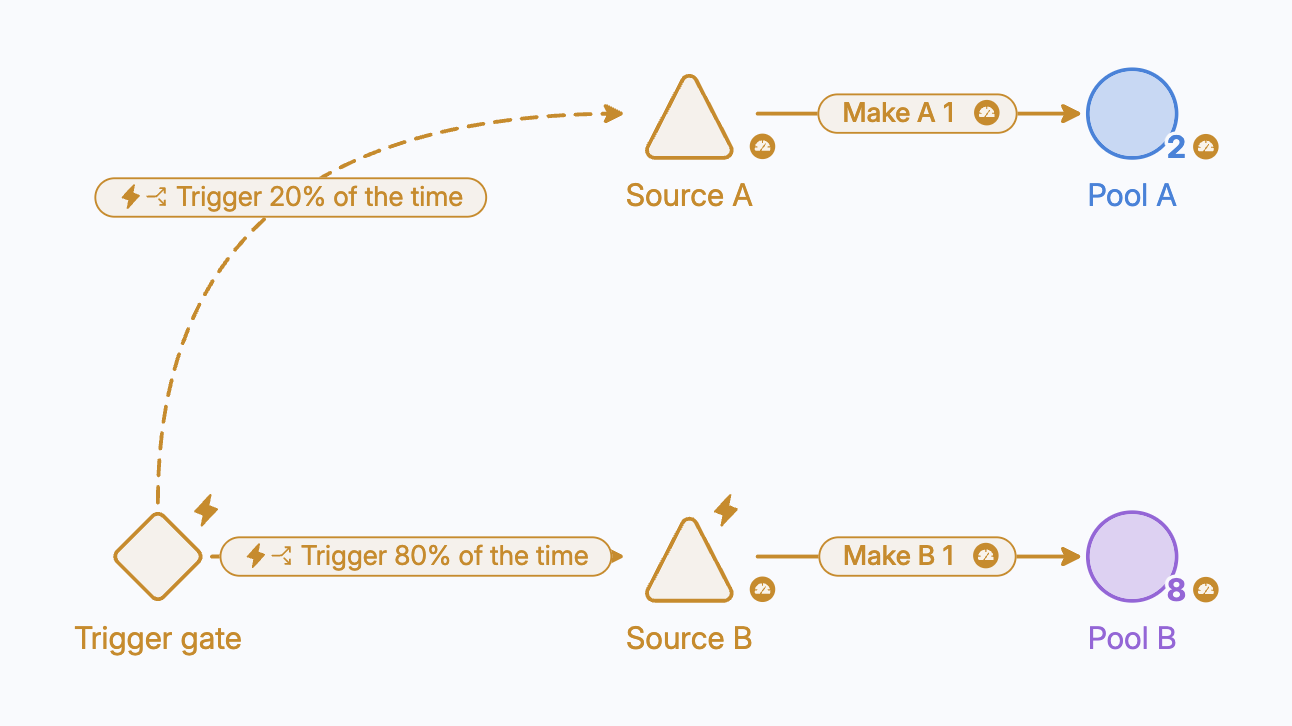
In Each Step, the Gate deterministically activates the Sources as many times as dictated by the Percentage values on their respective State Connection Formula. This ensures that the distribution of triggers is the same between different Plays. The order in which the sequence of activation is determined by an algorithm, is presented below:
- For Step 1, the gate always sends a resource on the first branch that was created. (identified by the node ID);
- On Step 2, the gate takes the step number (2) and multiplies it by the percentages on each path:
– Top path: 2*20% = 0.4
– Bottom path: 2*80% = 1.6
These values are compared with the values in the pools and the gate determines that at step 2, 1.6 triggers should be sent to the bottom path. Since decimal triggers can not be sent, a trigger is generated on the bottom path. - On Step 3, the gate takes the step number (3) and multiplies it by the percentages on each path:
– Top path: 3*20% = 0.6
– Bottom path: 3*80% = 2.4
The same comparison is also made for this step, resulting in the bottom path having 2.4 triggers. The gate checks that only 1 trigger has been sent so far on the bottom path and determines that this path should be triggered again. - The same functionality is repeated for steps 4-5
- For Step 6, the following percentages are computed:
– Top path: 6*20% = 1.2
– Bottom path: 6*80% = 4.8
The gate checks that 4 triggers are already sent on the bottom path, and the trigger is selected for the top path. - Following this rule, at the end of 10 steps, the following triggers will be sent:
– Top path: 10*20% = 2
– Bottom path: 10*80% = 8
Random
Random Trigger Gate with numeric Formulas
A Random Gate with no input and one or more State Connections as outputs, for which the Formulas have numeric values.
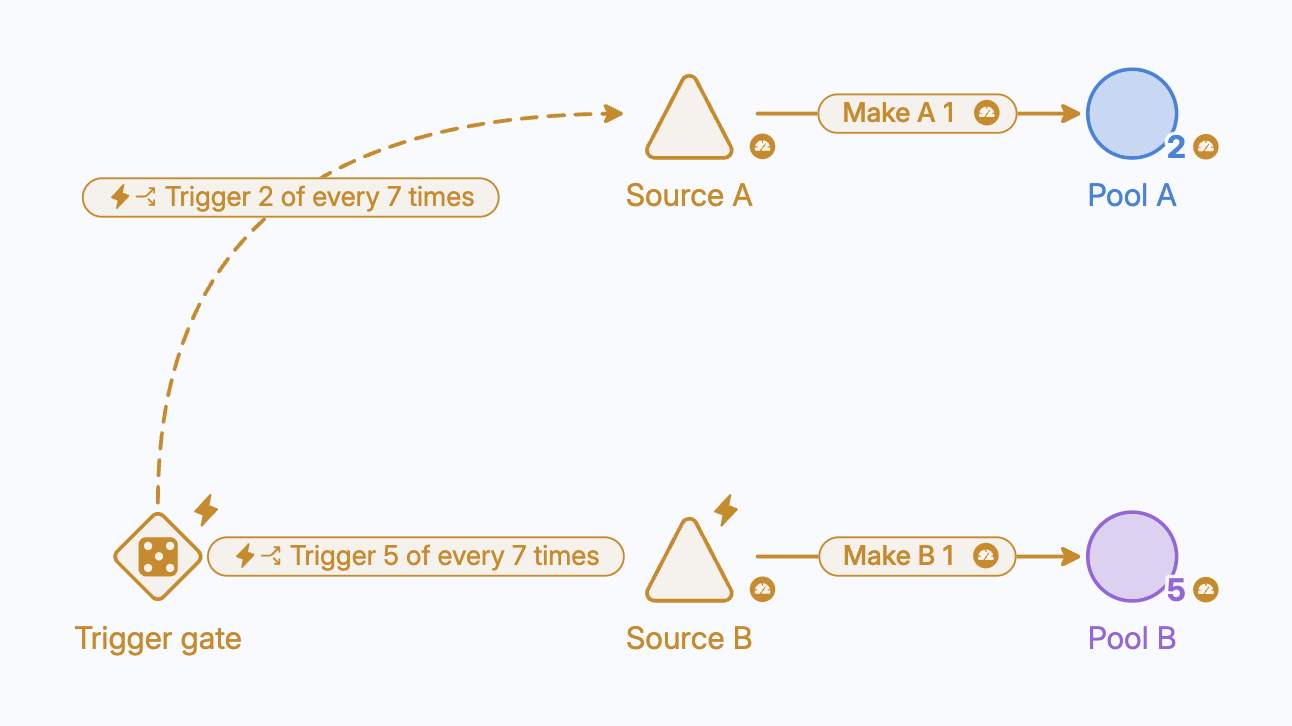
The Gate randomly activates the branches based on the numeric weights on the output State Connections. In this published example, the Gate recalculates the remaining branch weights after each activation in its cycle.
Here’s what happens in the example above:
At the start of the published cycle, the Gate determines the probabilities for each branch based on the probability weight of the outputs’ formula. These probabilities are computed by dividing the numeric value of each output by the sum of the remaining triggers to be sent.
- Top branch: 2/(5+2)*100 ≈ 28.6%
- Bottom branch: 5/(5+2)*100 ≈ 71.4%
After a trigger is sent, regardless of the selected branch, the above-mentioned formulas will be updated based on the remaining triggers to be sent. If the bottom branch is selected, on the second step the formula will be:
- Top branch: 2/(4+2)*100 = 33.3%
- Bottom branch: 4/(4+2)*100 ≈ 66.7%
Random Trigger Gate with conditional Formula
A Random Gate with no input and one or more State Connections as outputs, for which the Formulas have conditional values.
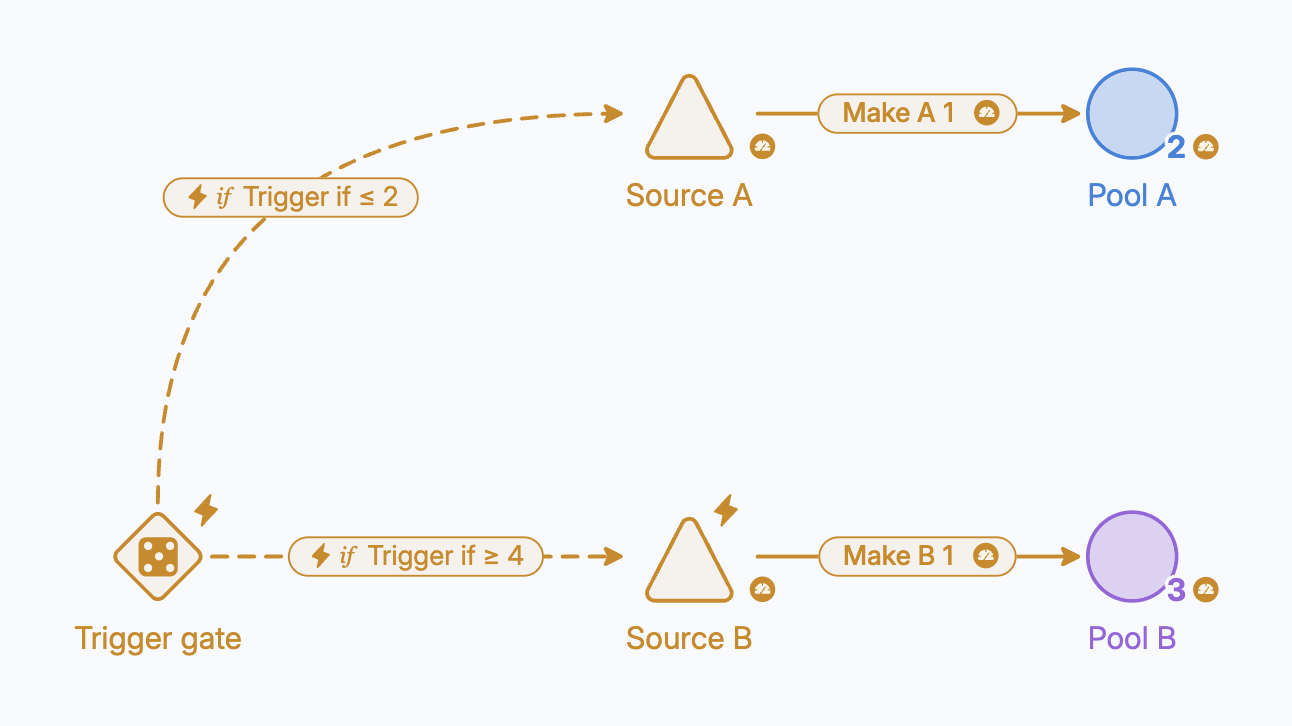
The published example uses a six-sided die.
Here’s what happens in the example above:
- The example rolls a six-sided die
- Any value between 1 and 2 will activate the upper branch
- Any value between 4 and 6 will activate the lower branch
- 3 will be skipped, as it doesn’t meet any of the triggering conditions
Random Trigger Gate with Percentage Formula
A Random Gate with no input and one or more State Connections as outputs, for which the Formulas have Percentage values.
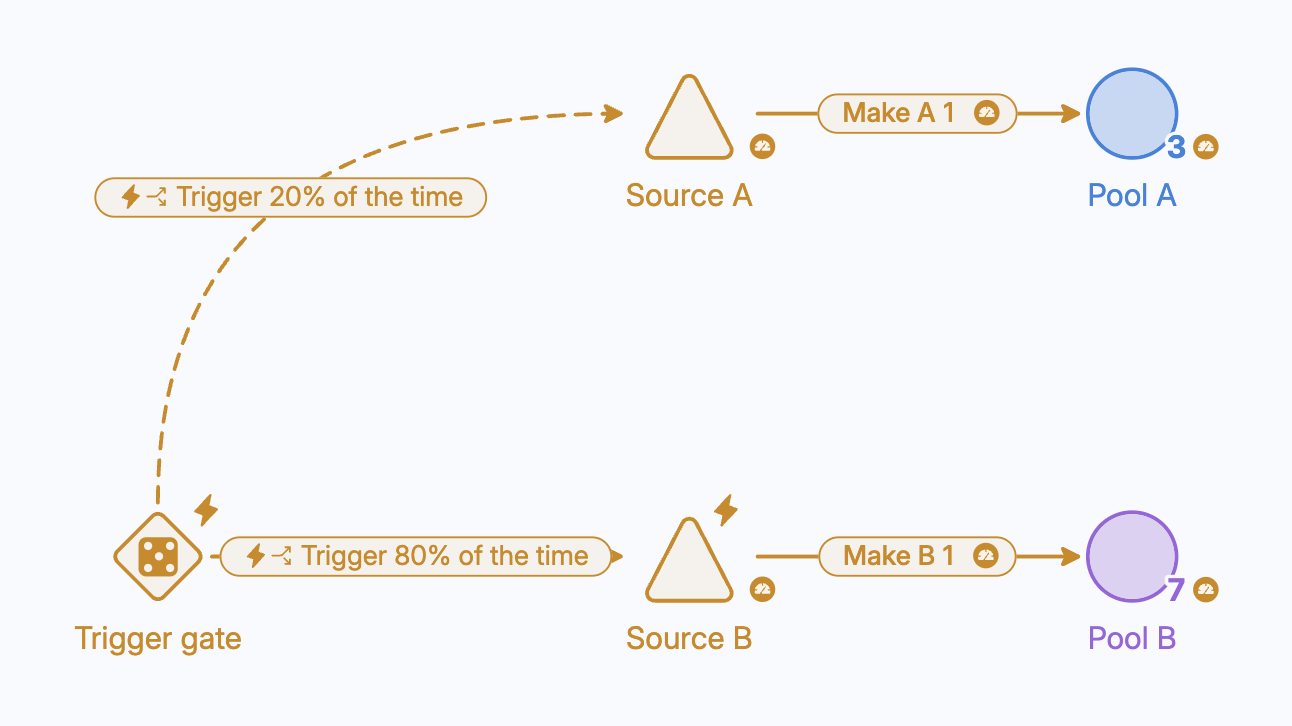
The Gate randomly activates the branches, but the State Connections’ percentage weights determine the number of triggers sent. It must be noted that since the triggered branch is randomly selected, independent of the outcomes of previous steps, the number of triggers sent on specific paths can be different from one Play to the next.
Here’s what happens in the example above:
For each step, the top branch has a 20% chance to be triggered, while the bottom branch has an 80% chance to fire. As mentioned previously, after 10 steps, the gate will not ensure that 2 triggers are sent to the top path and 8 triggers are sent to the bottom path. An 8–2 split is possible, but it is not guaranteed over just 10 Steps.
If the sum of the outputs’ percentages is smaller than 100%, there will be a chance of (100-sum_outputs)% for the random gate to not send a trigger for that step.
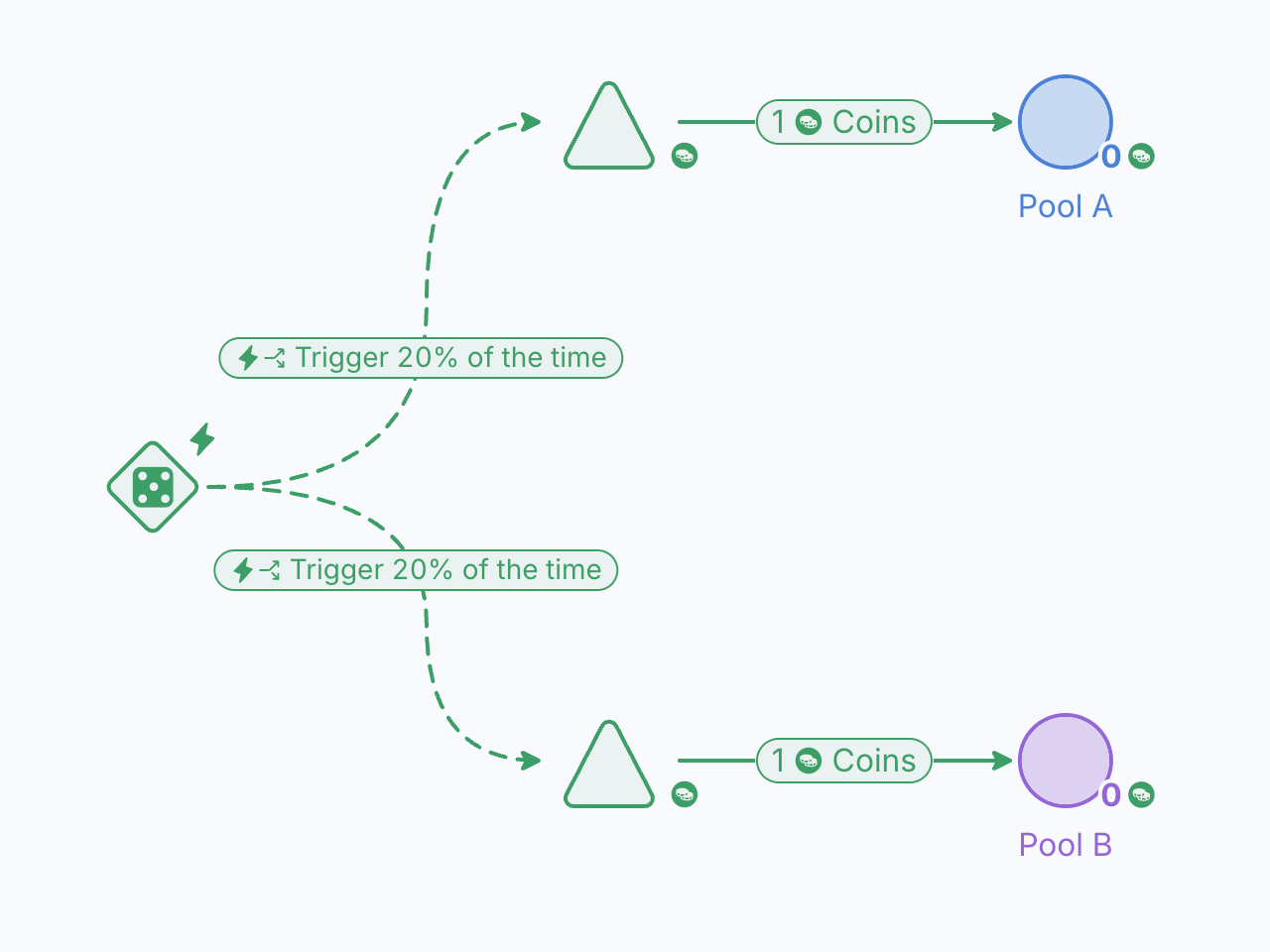
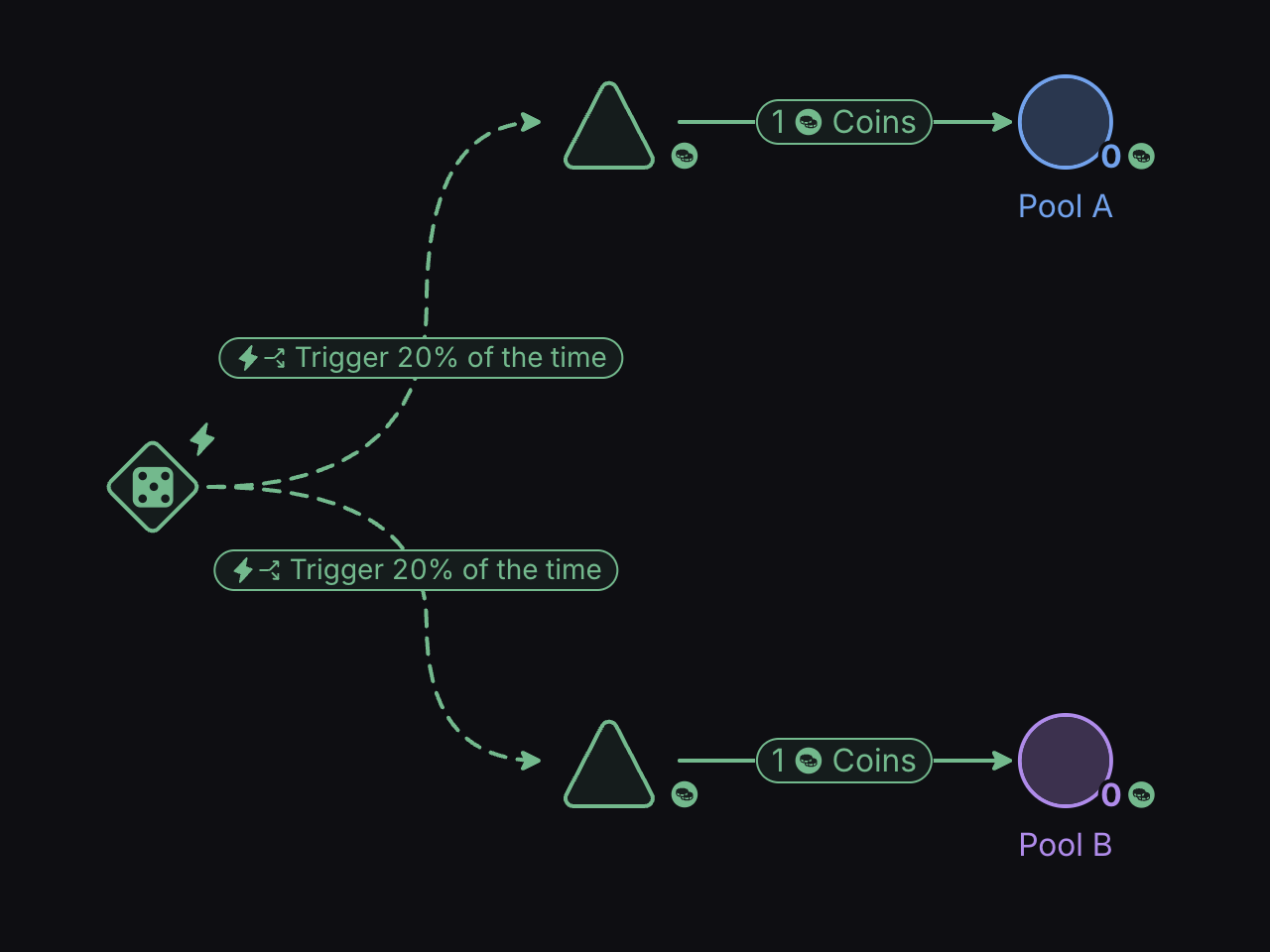
For the presented scenario, where branch 1 = 20% and branch 2 = 20%, the gate will not send the trigger for 60% of steps (100%-20%-20%). To achieve this result, the gate considers it has an additional output, with its formula = 60% (100% – the sum of outputs), which will ensure that the trigger is not sent to any node when this branch is selected.
When the sum of outputs is greater than 100%, we observe similar results for Deterministic Trigger Gates with Percentage Formulas. The only distinction between the two is that deterministic gates will consistently send their triggers in the same order for each cycle.
If the sum of the outputs’ percentages is larger than 100%, the random gate will normalize its outputs between 0 and 100%
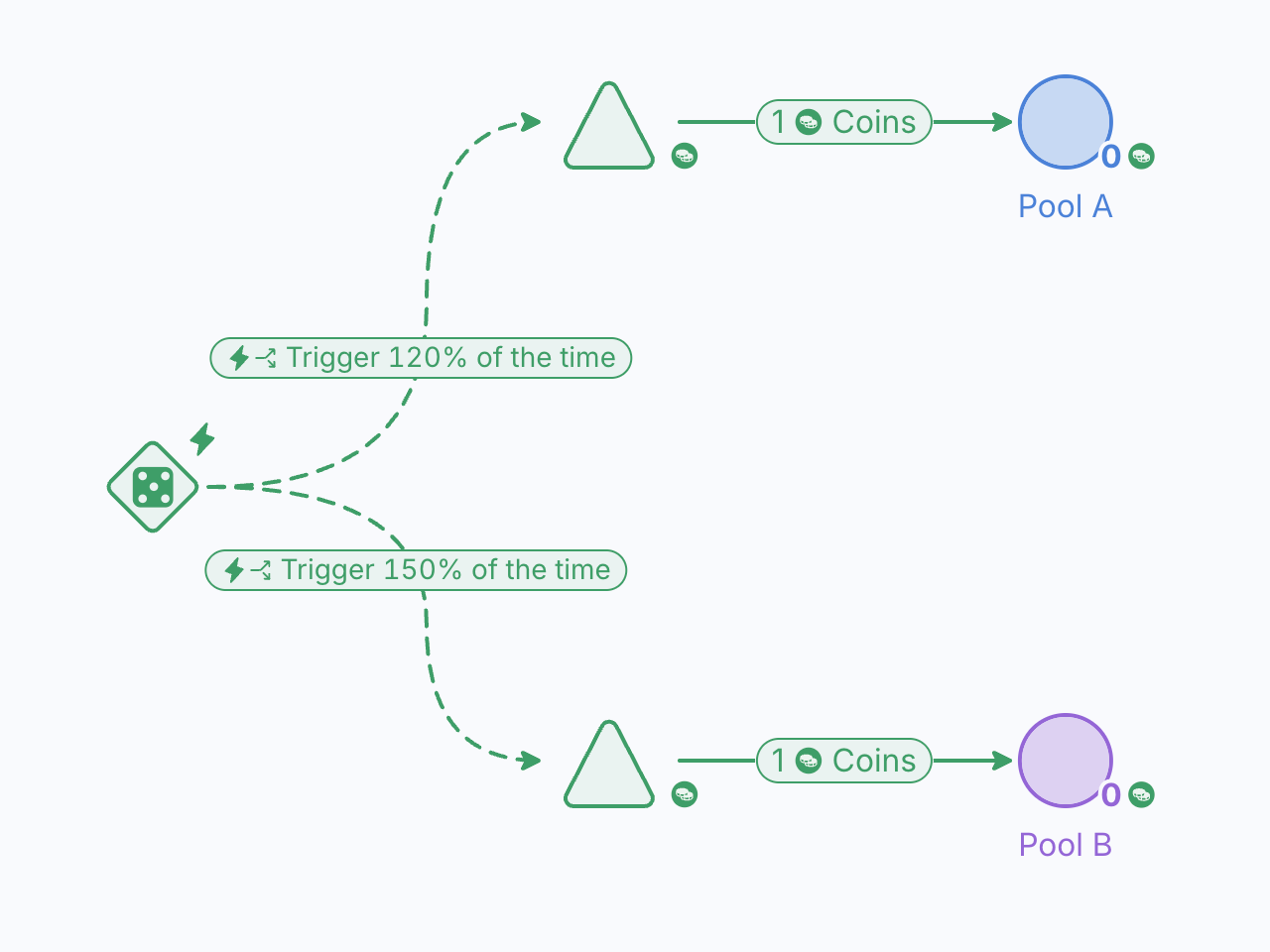
To normalize the outputs to 100%, the gate uses the Rule of Three. This generates the following results for the presented diagram:
– Top branch: 120*100/(120+150) = 44.4%
– Bottom branch: 150*100/(120+150) = 55.5%