Free-to-play economy modeling
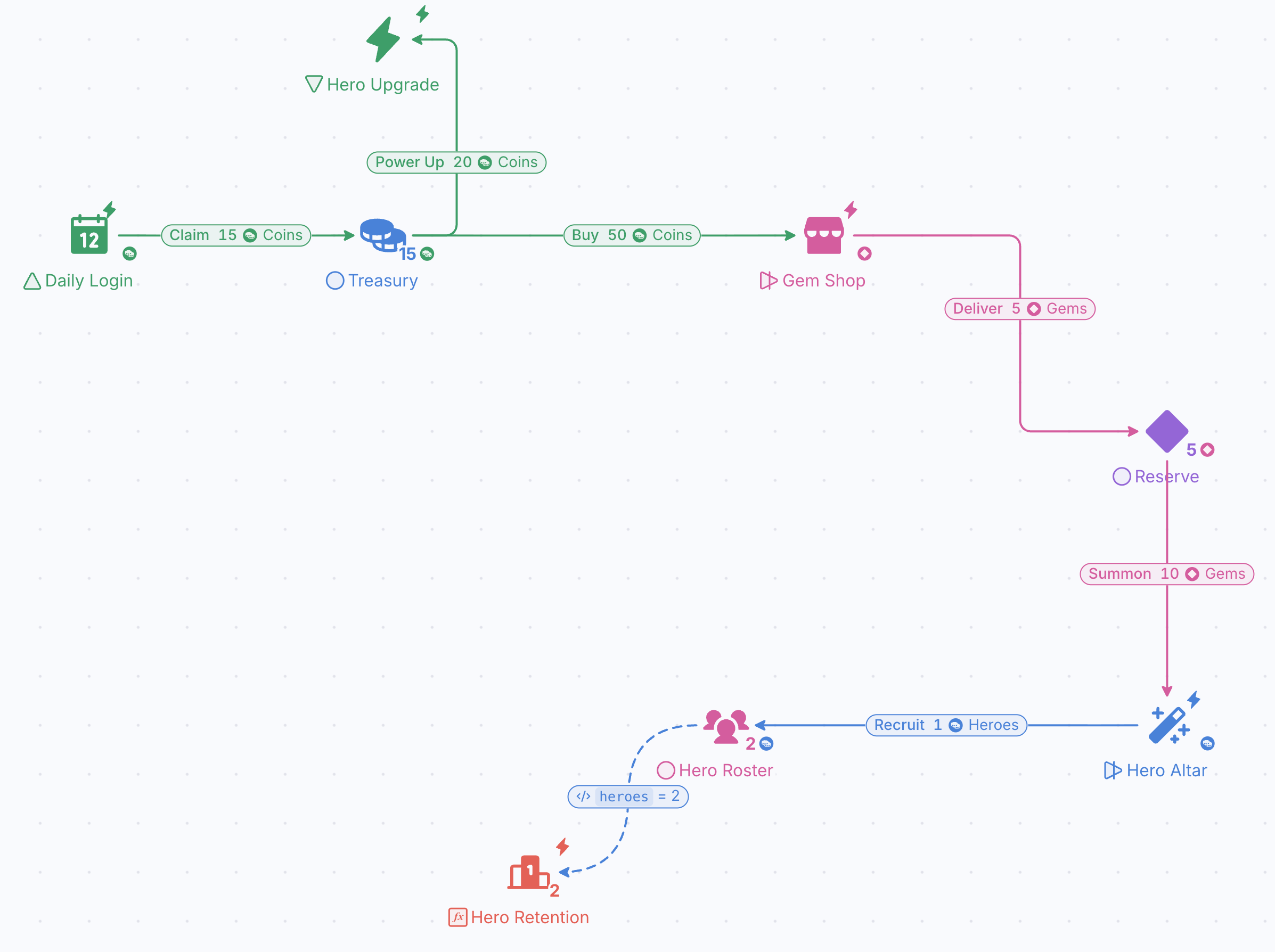
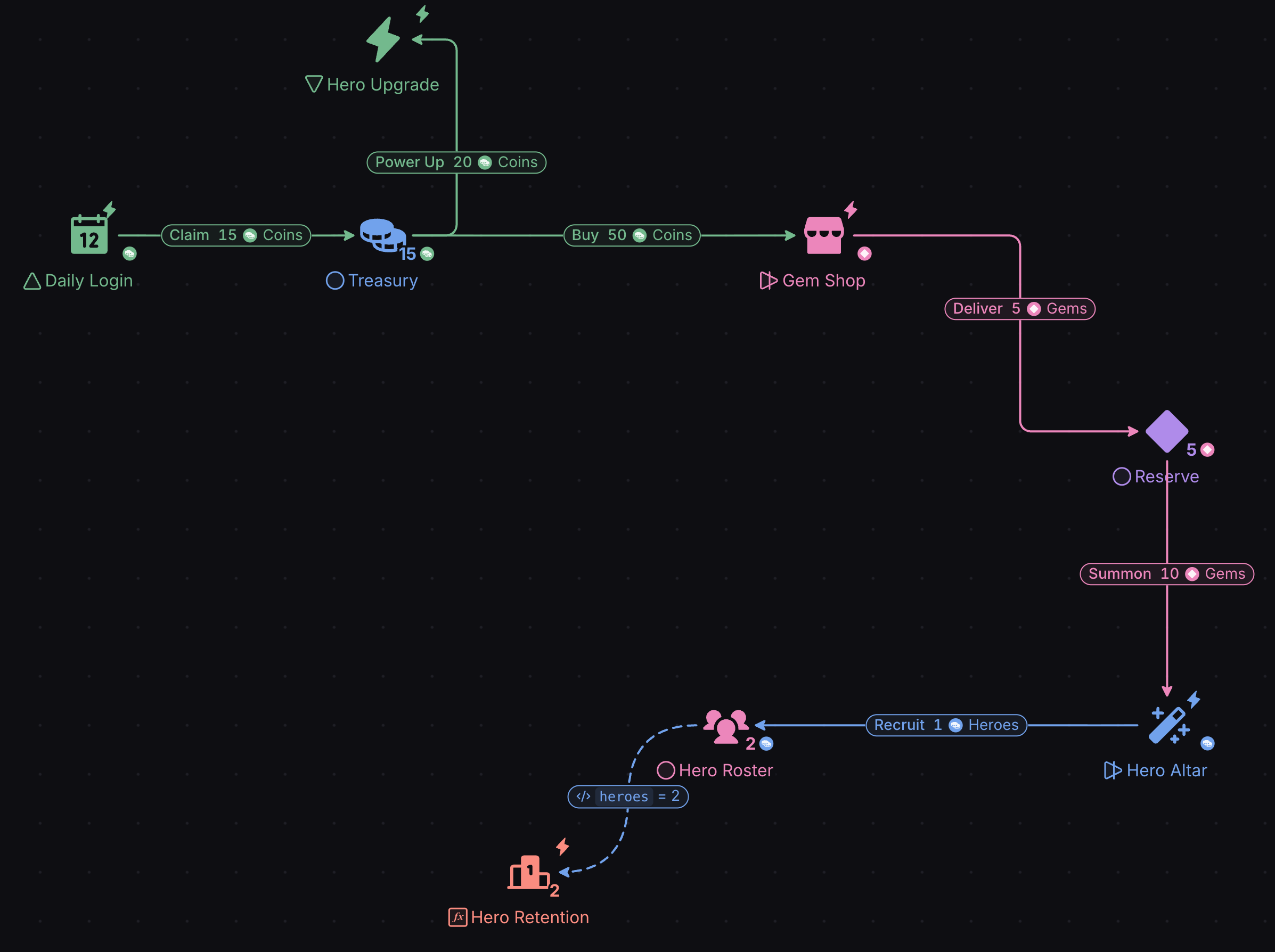
Make the rules that connect player actions, progression, rewards, purchases and resource circulation visible, so design and economy teams can inspect the experience as a system.
Trusted by Gaming Studios and Companies around the World





Design, simulate, and optimize your F2P game mechanics for unparalleled player engagement and revenue growth
Design
Create playable diagrams for any system, regardless of complexity. Make feedback loops and economies easier to validate, communicate and understand.
Predict
Gain data-driven insights by employing out-of-the-box Monte Carlo simulations. Test what-if scenarios and measure their impact in a safe, virtual environment, with one click of the button.
Balance
Move the Levers of a model, Forecast what each change does and compare the Outcomes of every Scenario, so a system is balanced on evidence rather than trial and error.
What you can do with it
Currencies and resources
Simulate supply and demand of currencies and resources for a stable, fair economy.
Purchases and ads
Compare monetization models and ad placements for their effect on revenue and player experience.
Retention
Test engagement mechanics and find the points where players churn.
Progression
Model levels, skill trees and unlockable content to keep long-term play rewarding.
Events and challenges
Simulate limited-time events for their effect on participation and revenue.
Content updates
Predict how new levels, characters and features change engagement and retention.
Free-to-play balance: economy and player experience
In a free-to-play (F2P) game the economy has to keep paying and non-paying players both progressing and satisfied.
When it does, players stay and the community grows. When it feels like a paywall, they leave. The way to find the balance is to measure it: how far ahead does a spender get, and can a dedicated free player still compete?
This study models a generic strategy game where players gather resources, train armies and expand their territory. Players can watch ads or buy premium bundles for a slight progression advantage. The question is how big the power gap between a high spender and a standard player really is. The key metric is the register “Army power”, and one step is one minute of gameplay.
The model has three parts. In the currency section, standard gold comes from missions (10% of players a minute, 100 to 300 gold), mining (25%, 20 to 70) and PvP wins (5%, 400 to 600). Premium diamonds come from rare special missions (3% of players, 10 to 50) or bundles: 3% buy a small one (50 diamonds), 2% a large one (100) and 1% a premium one (250). Natural resources follow the model of similar gathering games: wood (30% probability, 1 to 20 pieces), stones (25%, 1 to 10), grains (45%, 1 to 20) and copper (10%, 1 to 5).
In the red section, converter nodes turn resources into buildings and units. An archery costs 30 wood, 40 stones, 20 grains and 3000 gold, a barracks 20 stones, 30 grains, 10 copper and 2000 gold, and each building built raises the cost of the next by 10. Archers cost 5 wood, 5 grains and 50 gold, soldiers 1 copper, 5 grains and 60 gold, and training a unit takes 5 minutes, which more archeries and barracks shorten.
A gray control panel sets how many players watch ads or buy bundles. Watching an ad lets 5% of them skip training time each minute, and spending lets players build structures without gathering the resources.
The question is how much premium actions change a player’s power compared to a free-to-play player. Forecasting 100 players over 2 hours of gameplay gives the average Army power per playstyle:
- Free players who never watch ads or buy: 2.8K (12 soldiers, 17 archers).
- Players who watch ads: 3.2K (14 soldiers, 18 archers).
- Players who buy bundles: 4K (17 soldiers, 20 archers).
- Players who use every premium advantage: 4.5K (20 soldiers, 21 archers).
At first glance that looks pay-to-win. The spread says otherwise: the top 2% of free players reach more than 4K, a higher power than 19% of the high spenders. Engaged free players can compete with spenders who barely play.
The same method applies to gacha and loot-box drop rates and pity counters. Probability disclosure is now required in South Korea (since March 2024), in China and in Brazil (from 2026), so the odds you publish should come from a model you have checked.
My favourite thing about Machinations is the visual representation. For me it was really like, yes, this is what I need to do my work. It saves me a lot of time, a lot of energy and a lot of stress.
Selected models to Play and remix: Selected game economy models, Selected reward system models.
Tune the free-to-play economy before soft launch
Model currencies, offers and retention, then Forecast spend and churn for every monetisation change you consider.
- ISO 27001 certified
- SSO & SAML
- GDPR compliant
- Trustpilot verified
- Red Herring Top 100
- Dealroom Rising Star