Supply chain modeling software
A visual model makes the flows and constraints between suppliers, inventory, production, transport and demand explicit, so teams can reason about dependencies across the network.
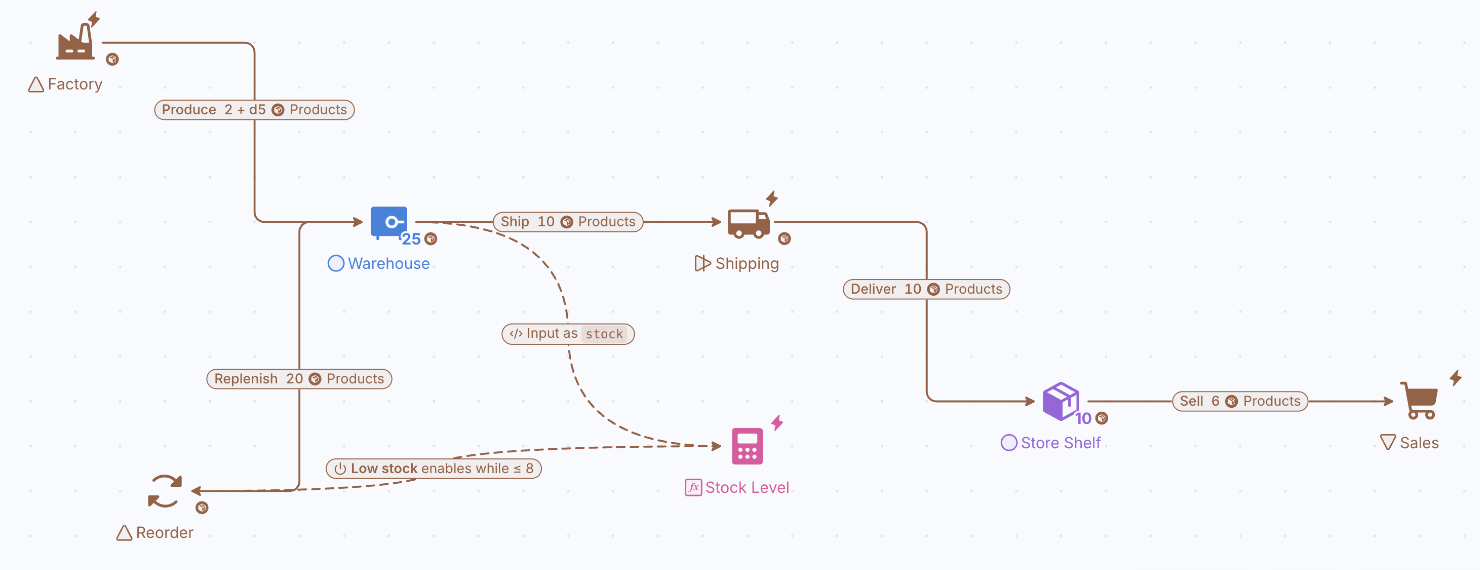
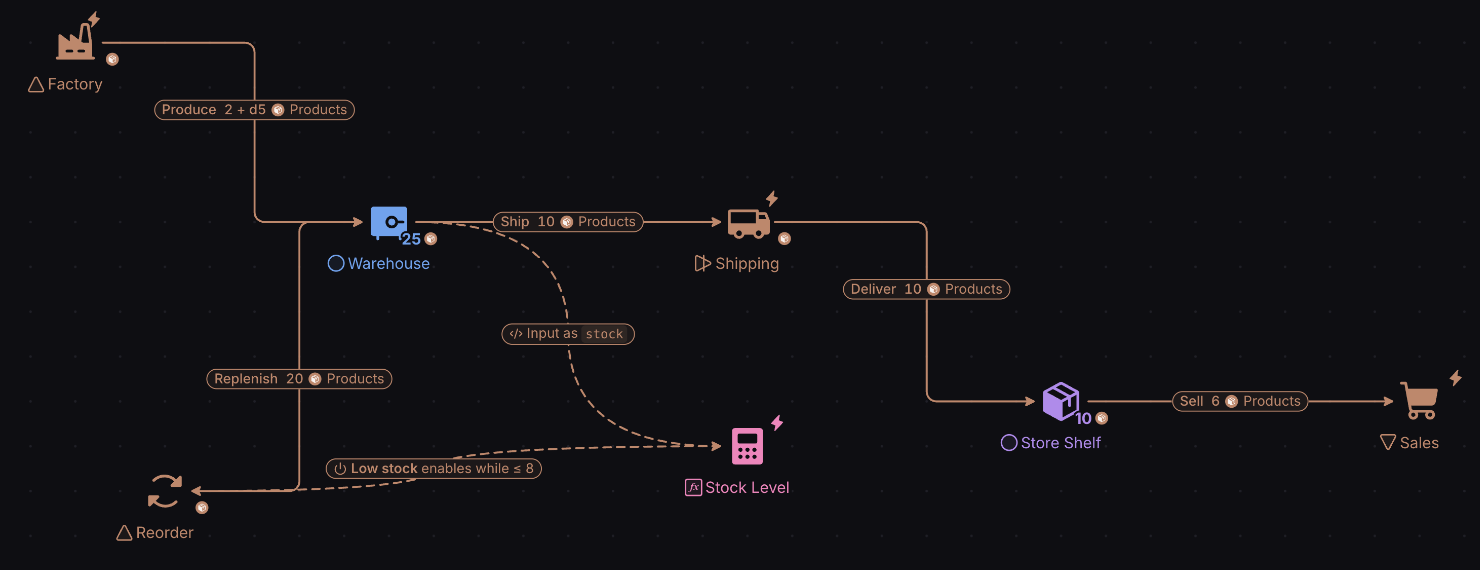
Streamline, analyze, and optimize every aspect of your supply chain to achieve unparalleled efficiency and performance at each step
Design
Create playable diagrams for any system, regardless of complexity. Make feedback loops and economies easier to validate, communicate and understand.
Predict
Gain data-driven insights by employing out-of-the-box Monte Carlo simulations. Test what-if scenarios and measure their impact in a safe, virtual environment, with one click of the button.
Balance
Move the Levers of a model, Forecast what each change does and compare the Outcomes of every Scenario, so a system is balanced on evidence rather than trial and error.
What you can do with it
Inventory levels
Simulate demand swings, lead times and reorder points across warehouses to cut holding costs and stockouts.
Demand forecasting
Test demand scenarios from historical data, trends and seasons to align production with the market.
Logistics and distribution
Simulate routes, shipping methods and delivery schedules across a network of locations.
Order fulfillment
Model order processing, picking, packing and shipping to shorten lead times.
Risk management
Model potential disruptions and test contingency plans to keep the supply chain running.
Cost analysis
Break down production, transport, warehousing and inventory costs and find where to cut without hurting service.
Managing Inventory Across Global Markets: Strategies for Minimizing Stockouts and Overproduction
The hard part of supply chain management is balancing stock across warehouses and distribution centers so it is where customers need it, when they need it.
Production schedules and demand have to move together, or you pay for stockouts on one side and holding costs on the other. A Machinations model lets you Play the whole chain, with demand swings, lead times and seasonality, and Forecast how often it breaks before it does.
This study models a generic phone manufacturer. Each day is one step and the system is Forecast with Monte Carlo runs. The aim is to predict next year from last year’s metrics, so that costs and sales demand stay in balance: minimize stockouts without overproducing the components that go into assembly.
The model starts with Production & Assembly. One phone needs 1 processor, 2 memory chips, 1 display, 1 battery and 10 sensors. A converter node consumes the parts and assembles a phone in 3 to 5 days, while chains of delay nodes and pools model each component’s batch time and delivery to the factory:
- Processors: 10K units per batch, 10 to 12 weeks to make, 7 to 12 days to deliver.
- Memory chips: 15K per batch, 8 to 12 weeks, 7 to 12 days.
- Displays: 10K per batch, 8 to 10 weeks, 10 to 15 days.
- Batteries: 8K per batch, 4 to 6 weeks, 7 to 10 days.
- Sensors: 50K per batch, 6 to 10 weeks, 7 to 10 days.
From the factory warehouse the phones go by air freight to six regions, using delay nodes for the wait: North America 7 to 10 days, South America 10 to 15, Europe 5 to 10, and Asia, Africa and Australia 5 to 7. Each region receives a share of the stock and sells at its own weekly rate, based on the previous year: North America 35% (200 to 350 phones a week), Europe 30% (250 to 300), Asia 20% (200 to 300), Australia 7% (40 to 60), South America 5% (20 to 50) and Africa 3% (10 to 30). The last system counts the stockout days of each region, so stock can be matched to region-specific sales.
Forecasting 1000 runs over one year gives these results:
- The first batch of phones is ready to ship after about 100 days (April 10), and 30,356 units are sold in total, with North America buying more than 10K.
- Average stockout days a year: Asia 106.43, Europe 37.63, North America 2.53, and zero in South America, Africa and Australia.
- Processors are the slowest part to arrive (11 to 14 weeks), but big batches and low use per phone keep them from being a bottleneck. Sensors are consumed fastest and cost the assembly line 2 to 3 weeks of waiting.
The model exposes the risk of long stockouts in Asia and Europe. Speeding up sensor production and giving Asia a larger share of the distribution would reduce them and lift sales.
Find the bottleneck before it finds you
Model suppliers, stock and lead times, Play a disruption and Forecast how far it ripples down the chain.
- ISO 27001 certified
- SSO & SAML
- GDPR compliant
- Trustpilot verified
- Red Herring Top 100
- Dealroom Rising Star