Educational game progression modeling
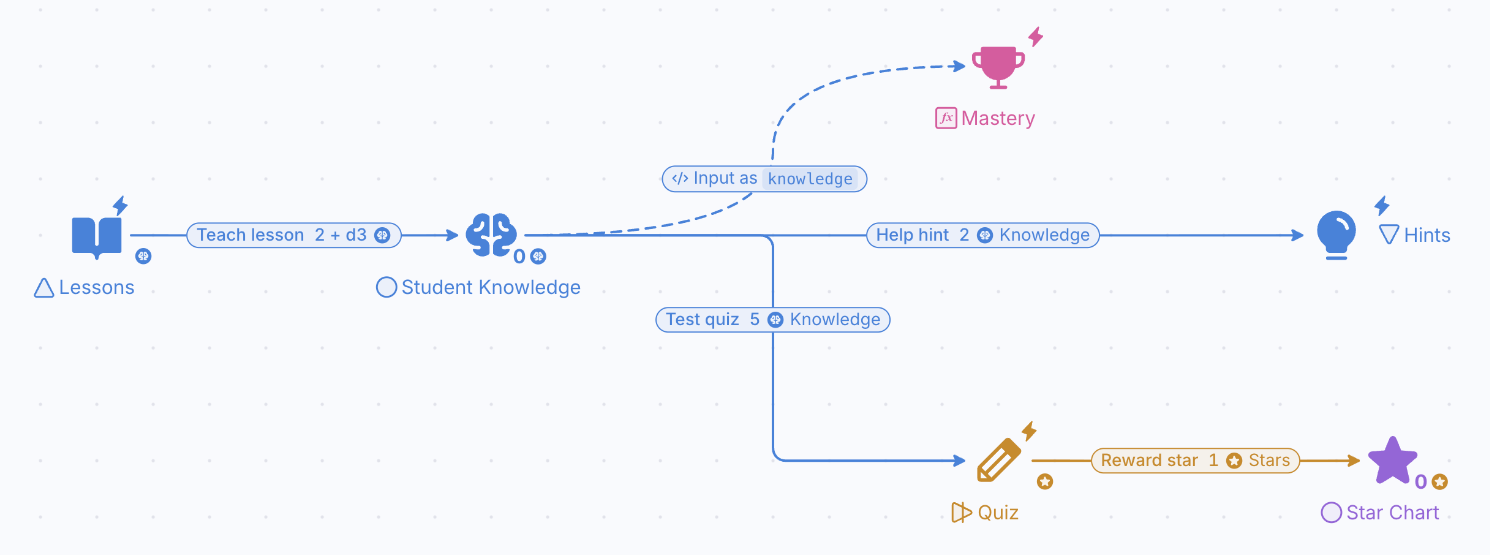
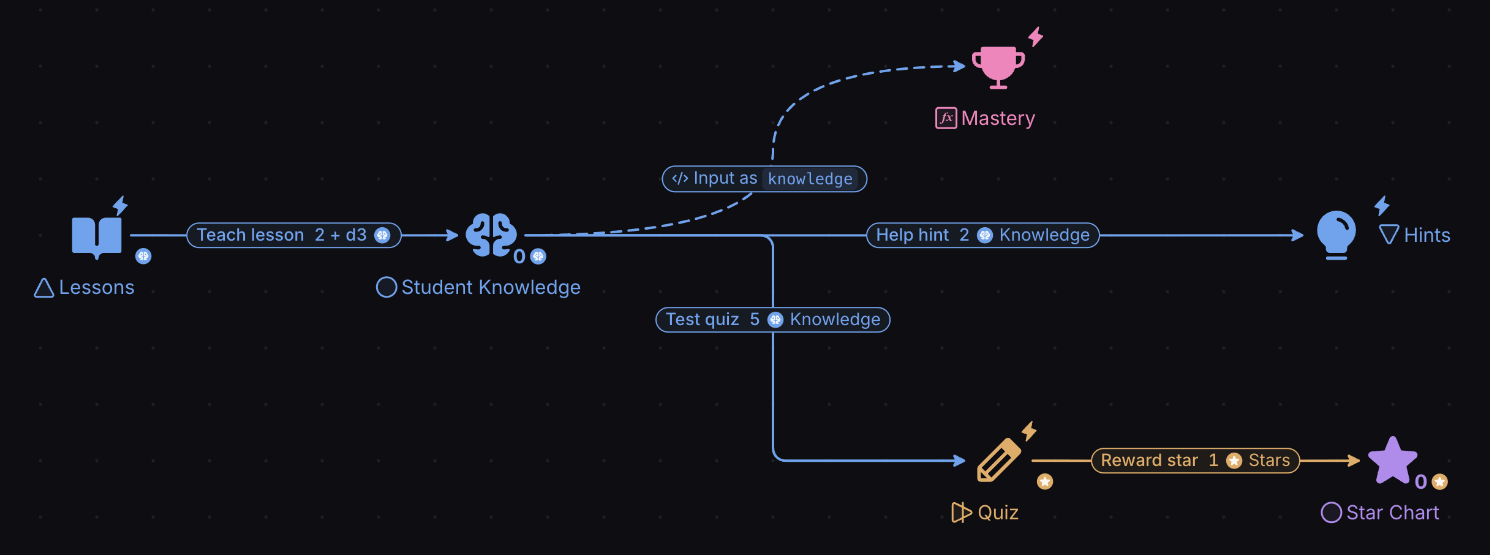
A diagram helps educators and designers discuss how the rules, feedback and progression of an educational game support the intended learning experience.
Trusted by Educational Games Studios around the world



Optimize educational game economies, mitigate risks, and accelerate development with playable diagrams and powerful prediction tools.
Design
Create playable diagrams for any system, regardless of complexity. Make feedback loops and economies easier to validate, communicate and understand.
Predict
Gain data-driven insights by employing out-of-the-box Monte Carlo simulations. Test what-if scenarios and measure their impact in a safe, virtual environment, with one click of the button.
Balance
Move the Levers of a model, Forecast what each change does and compare the Outcomes of every Scenario, so a system is balanced on evidence rather than trial and error.
What you can do with it
Educational design
Prototype educational games without coding to check coherence and speed up iteration.
Economy design
Balance the economy of an educational game with playable diagrams that predict outcomes.
Launch with confidence
Give every stage of development the same insights to decide faster.
Monte Carlo simulation
Run many plays of a system in minutes, with no extra set-up.
Scenarios, levers and outcomes
Mark the values worth moving as levers, forecast each scenario and compare the outcomes side by side.
Playable prototype
Play a system in the editor with one click to spot flaws and iterate quickly.
Gamifying education: Duolingo’s learning dynamics
A good educational game balances its rewards so learners stay engaged without being overwhelmed, tailors lessons to the individual, and tracks both engagement and what players actually learn. All of that can be modeled and tuned in Machinations.
This diagram models the core learning flow of Duolingo: the lesson types, progression between units, and the lives system.
A random gate with one output per lesson type picks the lesson. Duolingo has four: simple lessons (mixed exercises, 1 to 2 minutes), Stories (reading, 2 to 3 minutes), Radio (listening, 3 to 4 minutes) and Unit reviews (a small test of everything learned in the unit, 5 to 7 minutes, the most challenging). Simple lessons mix fill-in-the-blank, word pairing and full-sentence translation, Stories test reading comprehension and Radio lessons play conversations and ask questions. New learners get only simple lessons in the first two units, so the gate’s chances change with the number of units completed and harder types appear more often later.
A sequence of registers checks whether the learner has reached a unit review or has completed one. Units 1 to 3 take 4 lessons each, units 4 to 6 take 8 and units 7 and 8 take 9. When a unit is completed, the difficulty meter rises exponentially, which raises the chance of mistakes and shifts the ratio of lesson types towards more complex exercises.
Learners start with 5 lives and a 2% chance of losing one in the first unit. They need at least one life to start a lesson, and lives refill every 4 hours.
Forecasting 180 steps (3 hours of learning, one step a minute) shows:
- 97% of users reach unit 7.
- 88% complete 39 or 40 lessons.
- Only 16% make 5 mistakes and run out of lives.
My favourite thing about Machinations is the visual representation. For me it was really like, yes, this is what I need to do my work. It saves me a lot of time, a lot of energy and a lot of stress.
Make the learning loop as strong as the game loop
Model challenges, feedback and progression, then Play a term of lessons and see where learners stall.
- ISO 27001 certified
- SSO & SAML
- GDPR compliant
- Trustpilot verified
- Red Herring Top 100
- Dealroom Rising Star